

You choose a wick by the inside diameter of the jar or candle. At Naturcera the size range is in the product name (4–5, 5–6, 6–7, 7–8 and 8–9 cm), as an ECO or a cotton wick. Above 9 cm you work with two wicks or a wooden wick. The chart tells you where to start; the burn test tells you whether you got it right.
In 30 seconds
- Measure the inside diameter of the jar (or the diameter of the pillar) at its widest point and pick the wick for that range.
- Naturcera has five ranges, from 4–5 to 8–9 cm, as ECO wicks with a cellulose core or as cotton wicks. All pre-waxed, with a metal sustainer base, 15 cm long.
- Dense soy wax or a heavy fragrance load: if the candle tunnels, test the next range up as well.
- Over 9 cm: two wicks 5–6 cm apart, or a wooden wick.
- Tunnelling = wick too small. Soot, mushrooming and a very hot jar = wick too big.
Candle wick size chart: Naturcera wicks by diameter
Our wicks don't carry series numbers: the name tells you which candle diameter they are made for. Measure the inside of the jar with a ruler or calipers, at the widest point the melt pool needs to reach. For pillar and moulded candles, use the diameter of the candle itself.
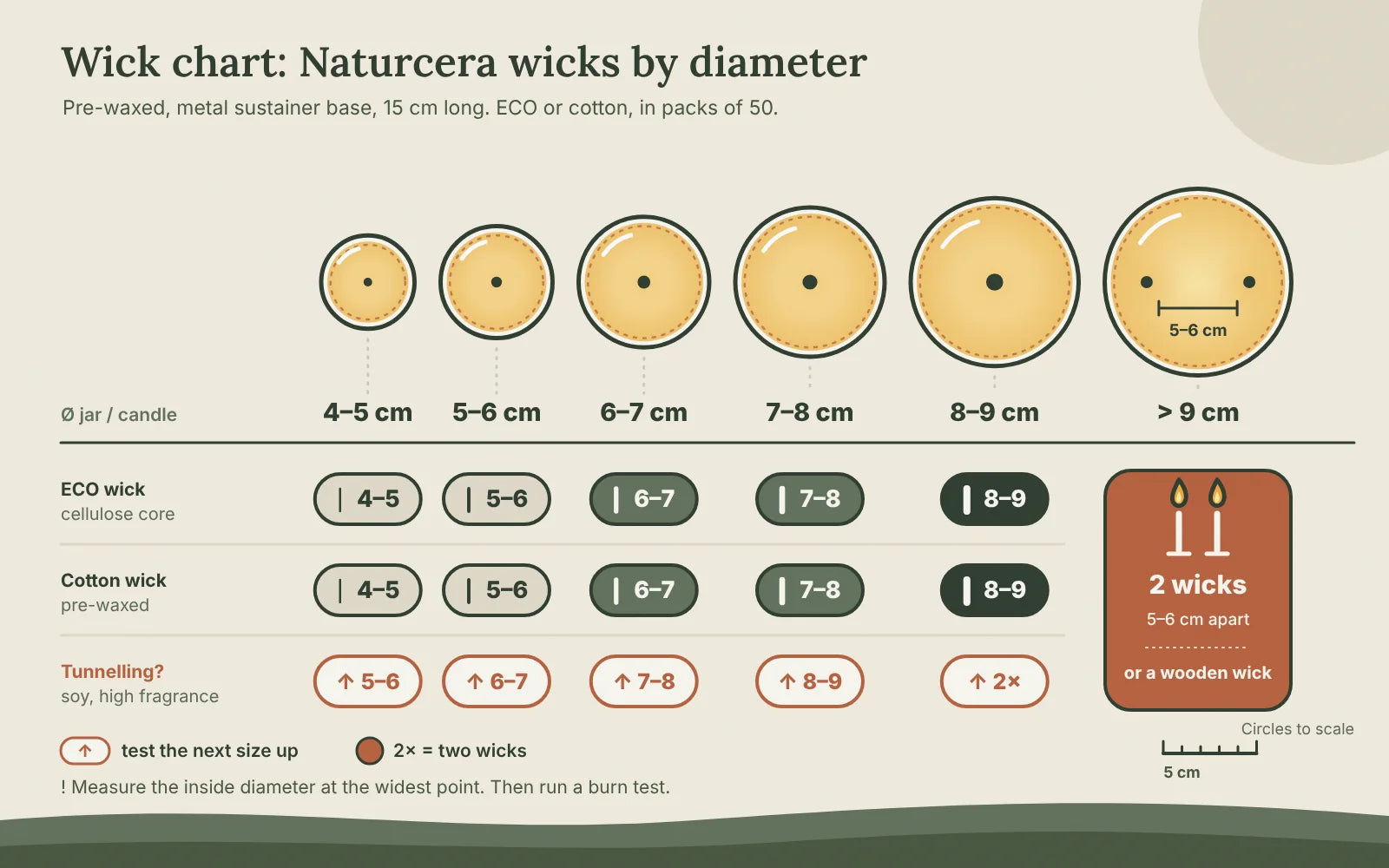
| Inside Ø of the candle | ECO wick (cellulose core) | Cotton wick | Tunnelling with soy or high fragrance? |
|---|---|---|---|
| 4–5 cm | ECO 4–5 cm | Cotton 4–5 cm | Test 5–6 cm |
| 5–6 cm | ECO 5–6 cm | Cotton 5–6 cm | Test 6–7 cm |
| 6–7 cm | ECO 6–7 cm | Cotton 6–7 cm | Test 7–8 cm |
| 7–8 cm | ECO 7–8 cm | Cotton 7–8 cm | Test 8–9 cm |
| 8–9 cm | ECO 8–9 cm | Cotton 8–9 cm | Switch to two wicks |
| Over 9 cm | Two (or more) wicks, 5–6 cm apart, or a wooden wick | Go one range up for each wick | |
What if the jar is exactly 7 cm? It sits on the line between two ranges. With paraffin, start with 6–7; with soy or a heavy fragrance load, with 7–8. If you can, pour a test candle with each and decide with the flame in front of you.
Notes by wax type
| Wax | Where to start | If it doesn’t work |
|---|---|---|
| Soy and plant waxes in containers | The range for your diameter | If it tunnels, the next range up. Even more so with a high fragrance load (the data sheet for our BPF soy wax allows 8–10%). |
| Paraffin in containers | The range for your diameter | Burns more fluidly: if the flame grows or the wick mushrooms, the range below. |
| Pillar or moulded candle (high-melt paraffin, rapeseed wax for moulds) | The range for your diameter | Here you don’t want a full melt pool: the thin wax wall holds the shape. If the wall melts through or wax runs out, the range below. |
Why does soy sometimes need more wick? Plant waxes are thicker when melted and burn cooler. The wick has to draw up more wax and deliver more heat for the melt pool to reach the edge.
ECO, cotton, wood or unwaxed reel: what’s the difference?
| Wick | What it is | When it makes sense |
|---|---|---|
| ECO | Cellulose core, made in Spain. Pre-waxed, metal base, 15 cm. Pack of 50. | Container and moulded candles in soy, paraffin, coconut or plant wax blends. |
| Cotton | Pre-waxed cotton wick, same base, same length, same ranges. Pack of 50. | The same uses. Cheaper per pack. |
| Wood | Wooden wick with holder. Pack of 50. | Container candles where you want the crackle and a decorative look; also an alternative to double wicks in wide jars. Tested the same way. |
| Unwaxed reel (61 m) | Continuous wick, no wax, no base. | Custom production: heights that don’t fit 15 cm, or volumes where waxing and assembling yourself pays off. |
There is no universal winner between ECO and cotton: both cover the same diameters and are trimmed the same way to the candle’s height. The difference is in how they are built, and what matters is how each one burns with your wax, your fragrance and your jar. If in doubt, pour one candle with each.
The burn test, step by step
The chart narrows it down; the test decides. The practical way is to pour three test candles: the range from the chart, the one below and the one above. That way you compare side by side instead of over three evenings.
- Let the candle cure. Paraffin is ready after about two days; soy and plant waxes need more like one to two weeks for scent and burn to settle.
- Trim and centre the wick. Trim to about 5–6 mm before lighting. A crooked wick ruins any test; a metal wick centring bar saves you the trouble.
- No draughts. Flat surface, away from windows, radiators and fans. Set a timer.
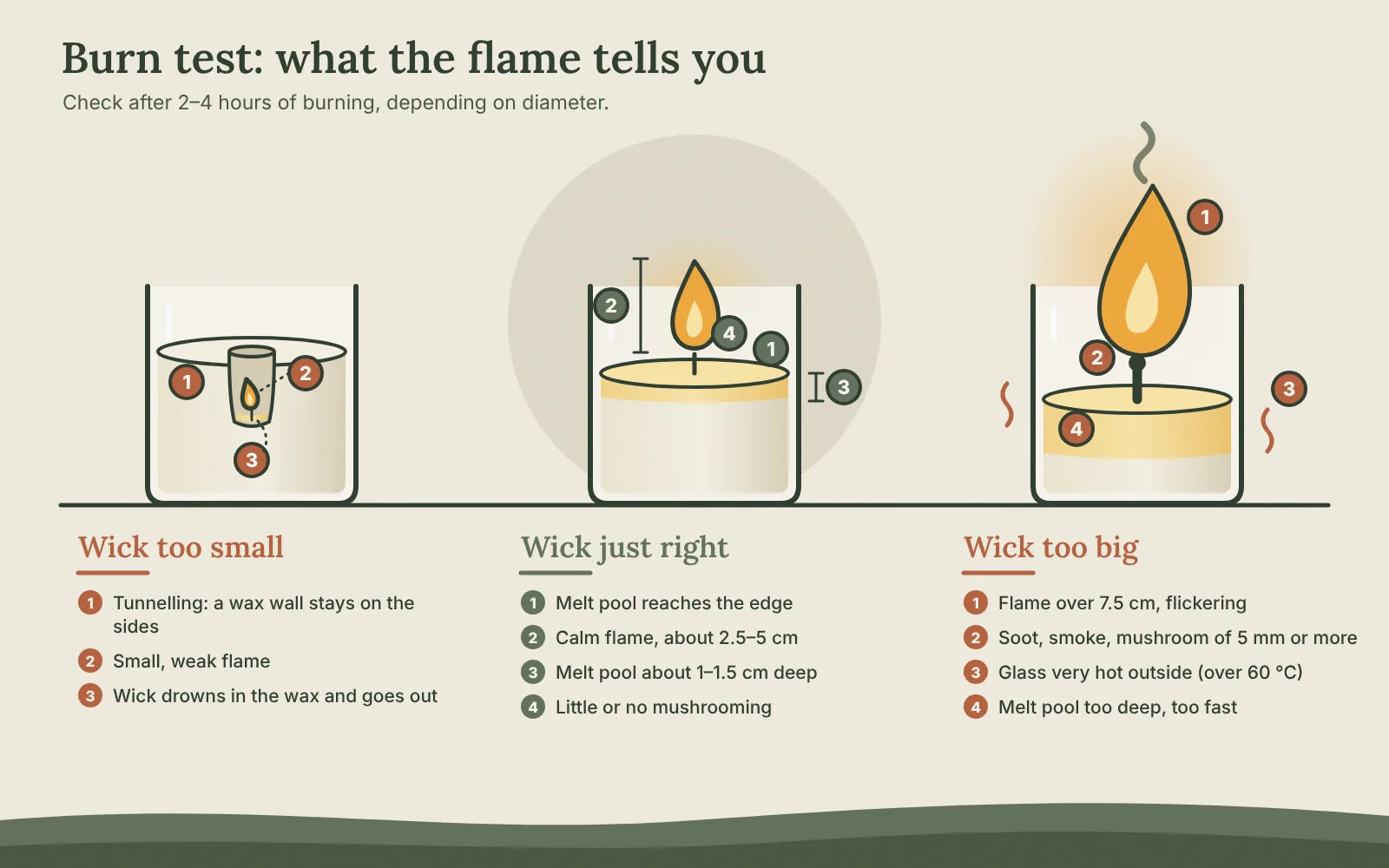
- After 1 hour: check the flame height. Calm and about 2.5–5 cm is a good sign.
- After 2–4 hours: does the melt pool reach the edge? How deep is it? Measure with a wooden skewer, not your finger.
- Extinguish, cool, repeat. Let it rest at least five hours, then relight until the candle is finished. The last 1–2 cm are the most critical: that’s where the jar gets hottest.
Diagnosis: wick too small or too big?
Signs of a wick that’s too small
- Tunnelling: the wick burns straight down and leaves a thick wall of wax at the sides. The most common problem with plant waxes.
- A small, weak flame that glows more than it burns.
- The wick drowns: liquid wax covers the tip and the flame goes out.
- Weak scent throw, because very little wax melts.
Signs of a wick that’s too big
- A tall, restless flame, over about 7.5 cm, that flickers or “dances”.
- Soot and smoke, with a blackened rim on the jar.
- Mushrooming: a carbon ball on the wick tip; from about 5 mm it’s a clear warning.
- A very hot jar: more than about 60 °C on the outside is too much.
- The melt pool is full within an hour and gets very deep.
A little tunnelling is a cosmetic flaw. A wick that’s too big is a risk: jars can crack and flames can get out of hand. When in doubt, go one range down and, if that’s not enough, try the other wick line (ECO or cotton).
What shifts the chart: fragrance, dye and vessel
Fragrance. For our candle fragrances we recommend 6–10% of the wax weight. At the top of that range viscosity and burn change, and the candle may need the neighbouring range. That’s why you always test the final recipe, not unscented wax.
Dye. Pigments can clog the wick and weaken it. Dissolved dyes interfere less, but the rule is the same: test with the colour in.
Vessel. A jar that widens towards the top needs more power at the top than at the bottom. Thick glass holds heat; thin glass loses it. Always measure the widest point the melt pool has to reach.
Over 9 cm: two wicks or a wooden wick
Above 9 cm there is no single-wick range. A very thick wick in a wide jar tends to grow its flame rather than its melt pool: it burns tall and still leaves wax at the sides. Two wicks spread the heat better. Place them 5–6 cm apart, each roughly in the centre of its half, and choose the range for the area each wick has to melt; in very wide vessels, three or more. The alternative is a wooden wick, crackle included. Either way, the burn test is the same.
The pre-waxed wicks come in packs of 50, and for custom production there’s the 61 m reel of unwaxed wick. Keep a test sheet for every combination of wax, fragrance, dye and vessel: wick and range, batch, flame height after one and four hours, jar temperature and soot. Change one component and you test again. If you sell in the EU, the reference standards are EN 15493 (fire safety), EN 15494 (safety labelling) and EN 15426 (sooting behaviour). For regular volumes, write to us at contacto@naturcera.com.
Frequently asked questions
Which wick for a 7 cm jar?
7 cm sits between the 6–7 and 7–8 cm ranges. With paraffin, start with 6–7; with soy wax or a heavy fragrance load, with 7–8. Ideally, test both.
ECO wick or cotton wick?
Both come in the same ranges from 4–5 to 8–9 cm, both are pre-waxed with a metal base and 15 cm long. The ECO wick has a cellulose core and is made in Spain. Pick the one that burns better with your wax in the burn test.
Which wick for a jar over 9 cm?
Two (or more) wicks 5–6 cm apart, or a wooden wick. A single, very thick wick usually gives you a tall flame before it gives you a full melt pool.
Why is my soy candle tunnelling?
Usually the wick is too small for such a thick wax, or the first burn was too short. Test the next range up and let the first burn run until the melt pool reaches the edge.
How long does a burn test take?
You get a first reading after 2–4 hours, but the test is only reliable once the candle has burned all the way down over several sessions.
Wicks for your next burn test
ECO wicks made in Spain and cotton wicks from 4–5 to 8–9 cm, wooden wicks and centring bars.
