

A candle produces black smoke when the flame gets more wax than it can burn with the oxygen available: whatever doesn’t burn comes out as soot. Most of the time the wick is to blame, either too long or too thick for the diameter, and the most visible symptom is a mushrooming wick. Trimming it to 5–6 mm before every burn fixes a good share of cases; the rest is solved with the right wick size, no drafts and the correct fragrance load.
In 30 seconds
- Soot = incomplete combustion. The flame is too big or too unsteady to burn everything that reaches it.
- Causes: oversized or untrimmed wick, drafts, too much fragrance, a narrow and tall jar, additives or dyes clogging the wick.
- The “mushroom” is a ball of carbon on the wick tip. Remove it when cold and trim before relighting.
- Right length: 5–6 mm above the wax. A calm flame of about 2.5–5 cm.
- To put it out without smoke: use a snuffer, or dip the wick into the melted wax and straighten it.
For this guide, start with candle wicks that fit the final application, then validate the complete formula in a small test before scaling.
Why a candle gives off black smoke
A candle is a small burner. The wick draws up melted wax by capillary action, the heat vaporises it and the flame burns it with oxygen from the air. As long as the amount of wax drawn up and the oxygen available are in balance, combustion is clean: the flame is calm, yellow and leaves hardly a trace.
When more fuel arrives than the flame can burn, the excess doesn’t fully oxidise and leaves as carbon particles: soot. You see it as a thread of black smoke, a dark ring on the rim of the jar or, over time, a grey shadow on the wall behind the candle. It depends less on the type of wax than on a correctly sized flame: any wax can soot with the wrong wick.
Quick diagnosis: what your candle is telling you
Light the candle somewhere without drafts and watch it for 20–30 minutes. Find your symptom:
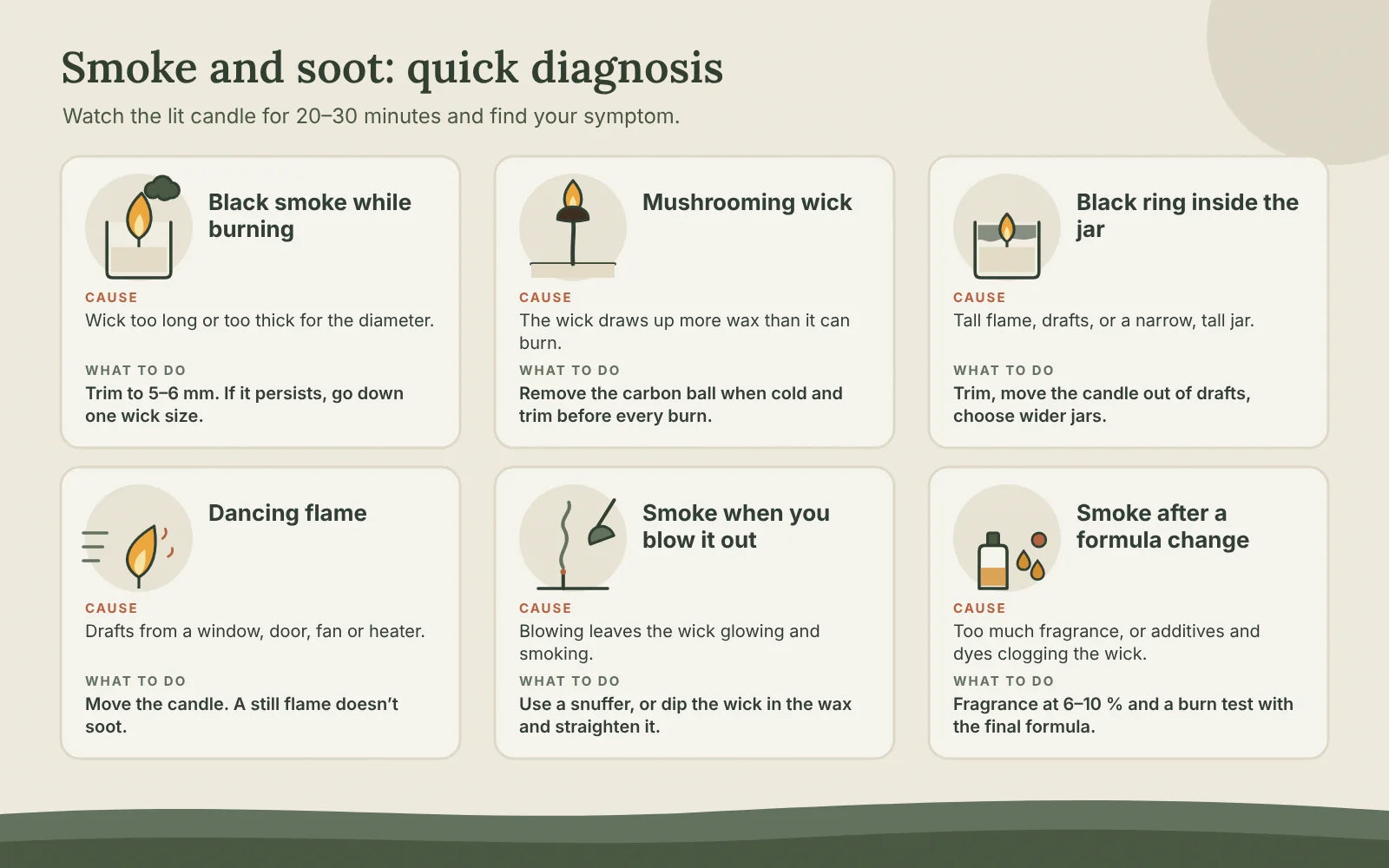
The causes, one by one
Wick too big for the diameter
If the wick is meant for a wider jar, it draws up more wax than the flame can burn. The flame is tall, often more than 7–8 cm, flickers, smokes and leaves the jar very hot. Trimming helps only for a while: the fix is to go down one size. Our wicks are chosen by inner diameter (4–5, 5–6, 6–7, 7–8 and 8–9 cm); if the candle smokes with your size, try the one below. Our technical guide to choosing candle wicks goes into detail.
Untrimmed wick
The most common cause in candles that are already in use at home. With every burn the wick gets a little longer, because the wax level drops and more wick is exposed. A 1–1.5 cm wick gives a far bigger flame than the one the candle was designed for. That’s why the rule is to trim before every burn, not just the first time.
Drafts
A window, a door opening, a fan or air from a heater make the flame dance. A flickering flame burns badly: every time it wavers it cools for an instant and releases soot. If the candle only smokes in one particular spot at home, you have your answer.
Too much fragrance
Fragrance burns too. Go beyond what the wax can hold and the flame gets more fuel, so the candle may smoke or “sweat” oil. For our candle fragrances we recommend 6–10 % of the wax weight, and the data sheet for our BPF soy wax allows 8–10 %. If you’re unsure how much to add, the maths is in how to calculate the exact amount of wax and fragrance.
Narrow or very tall jar
As the wax level drops inside a tall, narrow jar, air gets in less easily and swirls inside the glass. The flame stretches upwards looking for oxygen, flickers and blackens the top of the glass. If your design allows it, choose candle jars whose height isn’t much greater than their diameter.
Additives and dyes
Some pigment-based dyes don’t dissolve in the wax: they stay suspended and can clog the wick. The flame becomes irregular, soot appears or the mushroom grows sooner. The same happens with badly dosed additives. Use candle dyes at the rate on their data sheet and always burn-test the final formula.
Mushrooming wicks: what they are and what to do
The “mushroom” is a ball of carbon that builds up on the tip of the wick. It appears when the wick gets more wax than it can burn: the residue that doesn’t burn collects at the tip. A small mushroom at the end of a long burn is normal for many cotton wicks. A large one (from about 5 mm) or one that forms within the first hour means the wick is too big or there is too much fragrance.
What to do: put the candle out, wait for the wick to cool and remove the ball with a wick trimmer or a tissue. Trim to 5–6 mm and take the clippings out of the wax before relighting. If the mushroom quickly returns every time, the problem isn’t maintenance: go down one wick size.
How short to trim a wick: 5–6 mm
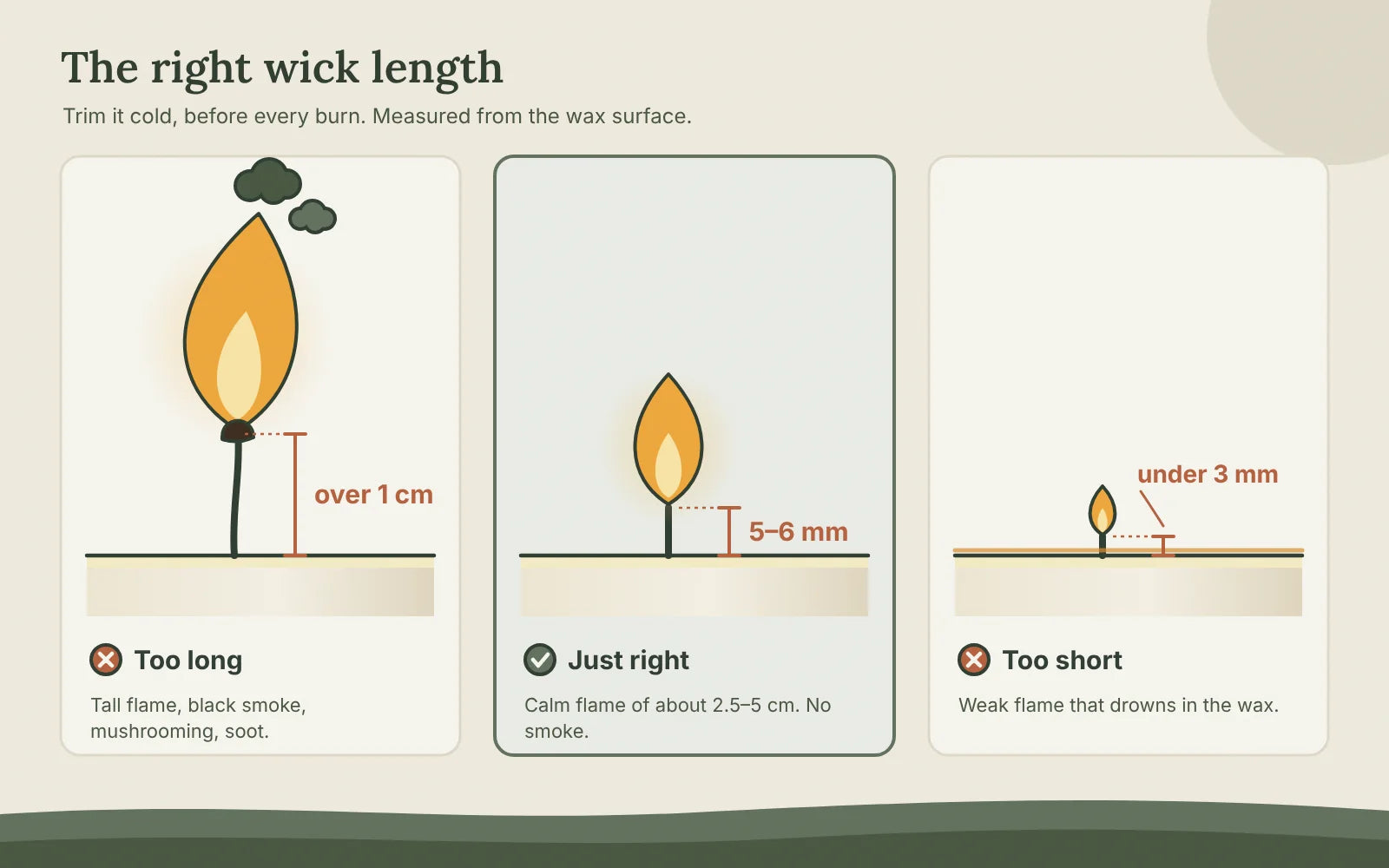
- With the candle cold. Trim when the wax is solid, not while it’s lit or the pool is liquid.
- To 5–6 mm. Measure from the wax surface. Longer means a tall flame and smoke; under 3 mm means a weak flame that drowns.
- With the right tool. A wick trimmer reaches the bottom of jars; scissors work on shallow candles.
- Remove the clippings. A bit of wick left in the wax burns like a second wick and dirties the jar.
- Centre the wick. If it has bent, straighten it while the wax is still soft after extinguishing. In production, a wick centring bar prevents the problem from the start.
How to put out a candle without smoke
| Method | Smoke | Notes |
|---|---|---|
| Blowing | A lot | The wick keeps glowing and smokes. It can also splash wax. |
| Snuffer (bell) | Little | Cuts off the oxygen without touching the wax. Hold the bell for a few seconds. |
| Dipping the wick | Almost none | With a wick dipper, bend the wick into the melted wax and straighten it again. It stays coated for the next burn. |
| Water | — | Never. It can make hot wax spit and crack the glass. |
A candle that smokes with a tall flame also overheats the jar. If the flame is clearly taller than 5 cm or the jar is too hot to touch, put it out, let it cool and trim. Keep candles away from curtains and shelves, and never burn them for more than 4 hours in a row.
Soot is a formula defect, not a customer one. For each combination of wax, fragrance, dye and jar, burn-test the wick size from the table and the one below, and note flame height, mushrooming and marks on the jar at 1, 2 and 4 hours. In the EU, the reference standard for the sooting behaviour of candles is EN 15426. Put “trim the wick to 5–6 mm before each use” on the label. If you need wicks or wax in volume, write to contacto@naturcera.com.
Frequently asked questions
Why is my candle producing black smoke?
Because the flame is getting more wax than it can burn. The usual causes are a wick that is too long or too big for the diameter, drafts, too much fragrance or a narrow, tall jar.
How short should a candle wick be trimmed?
To 5–6 mm above the wax surface, with the candle cold and before every burn.
Is a mushrooming wick bad?
A small mushroom after several hours is normal. If it is large or appears within the first hour, the wick is too big or there is too much fragrance. Remove it when cold and trim; if it keeps happening, go down one wick size.
How do I clean soot off the jar?
With the candle cold, wipe the inside rim with a dry or slightly damp tissue. Then trim the wick and remove the cause, or the soot will come back.
How do I put out a candle without smoke?
Use a snuffer, or dip the wick into the melted wax with a wick dipper and straighten it afterwards. Blowing produces the most smoke.
Materials for this project
For this guide, start with candle wicks that fit the final application, then validate the complete formula in a small test before scaling.
