


Making your own Advent wreath candles takes one weekend: pillar wax melted to 75–80 °C, poured at 70–75 °C into a 6–7 cm mould, topped up once and left to cool completely. The clever part is elsewhere – staggered heights, so candle 1 doesn't end up as a stub next to three nearly new ones. In 2026 the first Sunday of Advent is 29 November.
In 30 seconds
- Wax: paraffin pillar blend or rapeseed pillar wax. Container wax is too soft.
- Wick: Naturcera 6–7 cm size (also test 7–8 cm for 7 cm pillars or heavy scent), ECO or cotton, always with a test burn.
- Fragrance: around 6 % is enough in a pillar – cinnamon, fir, orange.
- Stagger the heights: each candle is one week's burn taller than the next, e.g. 22/18/14/10 cm.
- Pour by mid-November at the latest to be ready for 29 November.
For this guide, start with candle waxes that fit the final application, then validate the complete formula in a small test before scaling.
What is an Advent wreath, and why four candles?
The Advent wreath started in northern Germany in the 19th century and is now common in churches and homes across the UK, Ireland and North America. Four candles sit on a ring of evergreen: one is lit on the first Sunday of Advent, two on the second, and so on until the fourth, the Sunday before Christmas. Church wreaths are often purple with one pink candle for the third Sunday; German homes favour red, green or white. In Germany the standard is a freestanding pillar candle (Stumpenkerze) about 6–7 cm across, and Germans search for it as "Adventskranz-Kerzen selber gießen" – useful to know if you sell into that market.
Which wax for pillar candles?
Advent candles stand on a spike or plate with no container, so the wax has to be rigid, shrink slightly as it cools and release cleanly from the mould.
| Wax | Pros | Watch out for |
|---|---|---|
| Paraffin pillar blend | Easy release, smooth finish, strong colours | Sinkhole by the wick – plan a second pour |
| Rapeseed moulding wax | Plant-based, melting point 52–56 °C, pour at about 70 °C, handles much like paraffin | Sets more slowly, slightly more matte surface |
| Paraffin + stearic acid as hardener | Harder, longer-burning candle that drips less and releases more easily | 2–5 % of total weight, 3–5 % in soft paraffin. Above 5 % the candle turns brittle |
For a first batch, a ready-formulated paraffin pillar blend is the least fuss. If you want plant-based, use a rapeseed wax made for freestanding candles and allow an extra week. For pillars, Naturcera’s higher-melt paraffins fit well: 56–58 °C as powder or slabs, 62–64 and 64–66 °C, and high-melt pellets.
What you need
- Mould in polycarbonate, aluminium or silicone, 6–7 cm wide and at least as tall as your tallest candle.
- Wick (ECO or cotton), a wick bar or skewer, and putty to seal the wick hole.
- Thermometer, scales, a metal pouring jug and a pan for a double boiler.
- Optional: dye, fragrance oil, hardener.
Quantities: a 7 cm pillar takes about 35 g of wax per centimetre of height. The 22/18/14/10 cm set weighs just over 2.2 kg – not a small candle project, but a wreath that actually lasts until Christmas Eve.
Step by step: pouring pillar candles
- Prepare the mould. Thread the wick up through the base hole, seal it outside with putty and fix it taut and centred on the wick bar. Warm the mould for a minute with a hairdryer to avoid cold rings on the surface.
- Melt the wax in a double boiler to 75–80 °C, with the thermometer in the wax rather than touching the pan.
- Colour and scent. At about 80 °C dissolve the dye first, then weigh in the fragrance and stir gently for two minutes without whipping in air.
- Pour at 70–75 °C, slowly, down the side of the mould. Keep about 1 cm of wax back in the jug.
- Top up. After an hour or two a funnel forms around the wick. Poke two or three holes with a skewer and fill with the reserved wax, 5–10 °C hotter, only up to the original level – going over leaves a lip at the base.
- Let it cool. At room temperature, never in the fridge. Paraffin releases after 12–24 hours, once it is cold and solid; rapeseed takes longer to set, so allow at least a week in hand and light a test candle before you dress the wreath.
For deep red outside and pale wax inside: pour the candle white, let it set completely, then dip it several times into dyed wax. With no dye in the core, the flame burns cleaner.
Which wick for a 6–7 cm pillar?
The wick decides whether the candle burns evenly or tunnels. Naturcera sells wicks by candle diameter: for a 6 cm pillar take the 6–7 cm size, as an ECO wick with cellulose core or a cotton wick. For 7 cm, or a heavily scented wax, test the 7–8 cm size alongside it. The pre-waxed wicks are 15 cm long – for the 18 and 22 cm candles use the unwaxed wick roll and check the size in a test burn.
A test burn is not optional: burn for 2–3 hours. The melt pool should reach almost to the edge without breaking through, with a steady, soot-free flame. Tunnelling means the wick is too small; a tall, flickering flame and drips down the side mean it's too big.
Why make the candles different heights?
Candle 1 burns for four weeks, candle 4 for one. With four equal candles, by the fourth Sunday you have a stub beside an almost untouched pillar. The fix: each candle is taller than the next by exactly one week's burn.
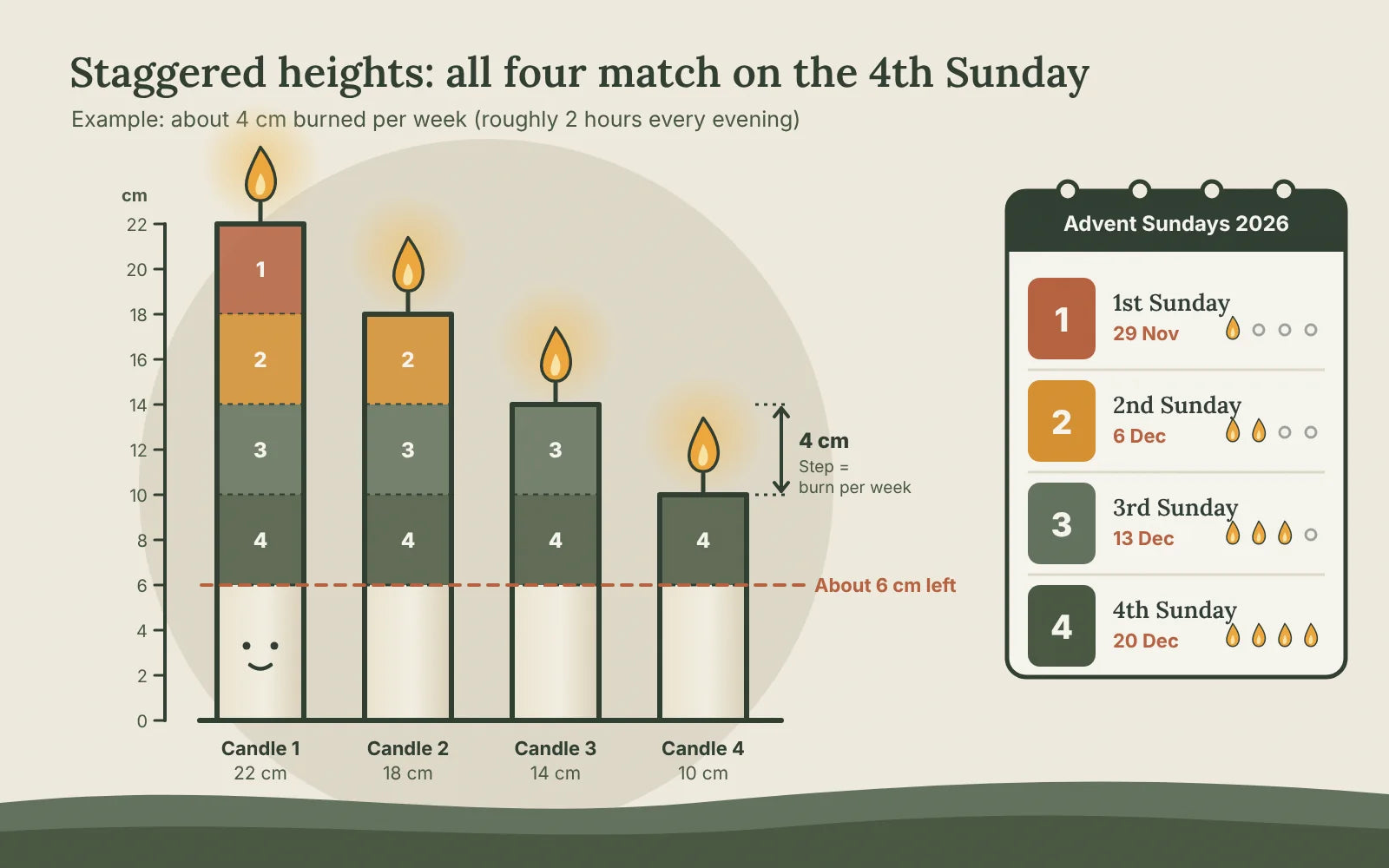
Working out the steps: a 7 cm pillar burns down roughly 0.3 cm per hour (a rough guide that depends on wax, wick and fragrance). Lit for about 2 hours every evening, that is around 4 cm a week. With 6 cm left at the end, you get 22, 18, 14 and 10 cm. If you only light the wreath on Sundays, the step shrinks to 1–2 cm. The most reliable number is the one you measure with a test candle from the same batch.
Christmas fragrances: which and how much
In a pillar, around 6 % fragrance oil by weight of wax (60 g per kg) is enough – the low end of the 6–10 % Naturcera recommends for its fragrances. More rarely smells stronger and often causes sweating and a restless flame. The classics: cinnamon, fir, orange and baked apple. Cinnamon notes can trigger labelling depending on the formula, so if you sell, check the fragrance's SDS and IFRA certificate, which Naturcera provides for its fragrances.
Mini calendar: when to start
| Dates 2026 | What to do |
|---|---|
| by 1 November | Order wax, wicks, fragrance and mould |
| 2–8 November | Test candle: check the wick and burn rate per hour |
| 9–15 November | Pour and top up the four candles |
| 16–27 November | Cooling and unmoulding (paraffin 12–24 h, rapeseed longer) |
| 28 November | Make the wreath, set the candles |
| 29 November | First Sunday of Advent: light candle 1 |
Safety: dry wreath, open flame
Fir branches dry out fast in a heated room and then burn like kindling. Set the candles on firm holders with drip plates, stand the wreath on a non-flammable surface, never leave it burning unattended, and put the candles out before the flame gets near branches or decorations. The staggered candle 1 must still finish well above the greenery – hence the 6 cm margin. From the third Sunday, check the needles regularly for dryness.
For German Christmas markets (Weihnachtsmärkte), the maths: a 22/18/14/10 cm set at 7 cm diameter takes about 2.2 kg of wax; at 6 cm, about 1.6 kg. A hundred sets means 160–220 kg of wax, plus wicks, fragrance and rejects. Many markets open in the second half of November, so production should be running in October: several moulds in parallel, one batch per scent and colour, and a documented test burn per batch. For sale in the EU, labels carry safety warnings to EN 15494 and the General Product Safety Regulation (GPSR) details. Naturcera supplies from around 1 kg to several hundred kilos with volume pricing; orders over 500 kg are handled by the sales team: contacto@naturcera.com.
How to make candles with silicone moulds without breaks or deformation · Candle wick size chart: which wick for which diameter?
FAQ
Can I use soy wax for Advent wreath candles?
Only a soy wax formulated for freestanding pillars. Container soy wax is too soft: it slumps and spills over the side.
Why does my pillar candle have a hole in the middle?
Wax shrinks as it cools, most of all around the wick. That's normal: poke the cavity and top up with slightly hotter wax.
When can I light the candle?
Once it is completely cold and solid all the way through, including around the wick. If you light it while the wax is still soft, it burns unevenly and can lose its shape.
What heights should the four candles be?
Each candle should be one week's burn taller than the next. At about 2 hours an evening and 7 cm diameter: 22, 18, 14 and 10 cm.
When is the first Sunday of Advent 2026?
Sunday 29 November 2026. The others are 6, 13 and 20 December.
Materials for this project
For this guide, start with candle waxes that fit the final application, then validate the complete formula in a small test before scaling.


