

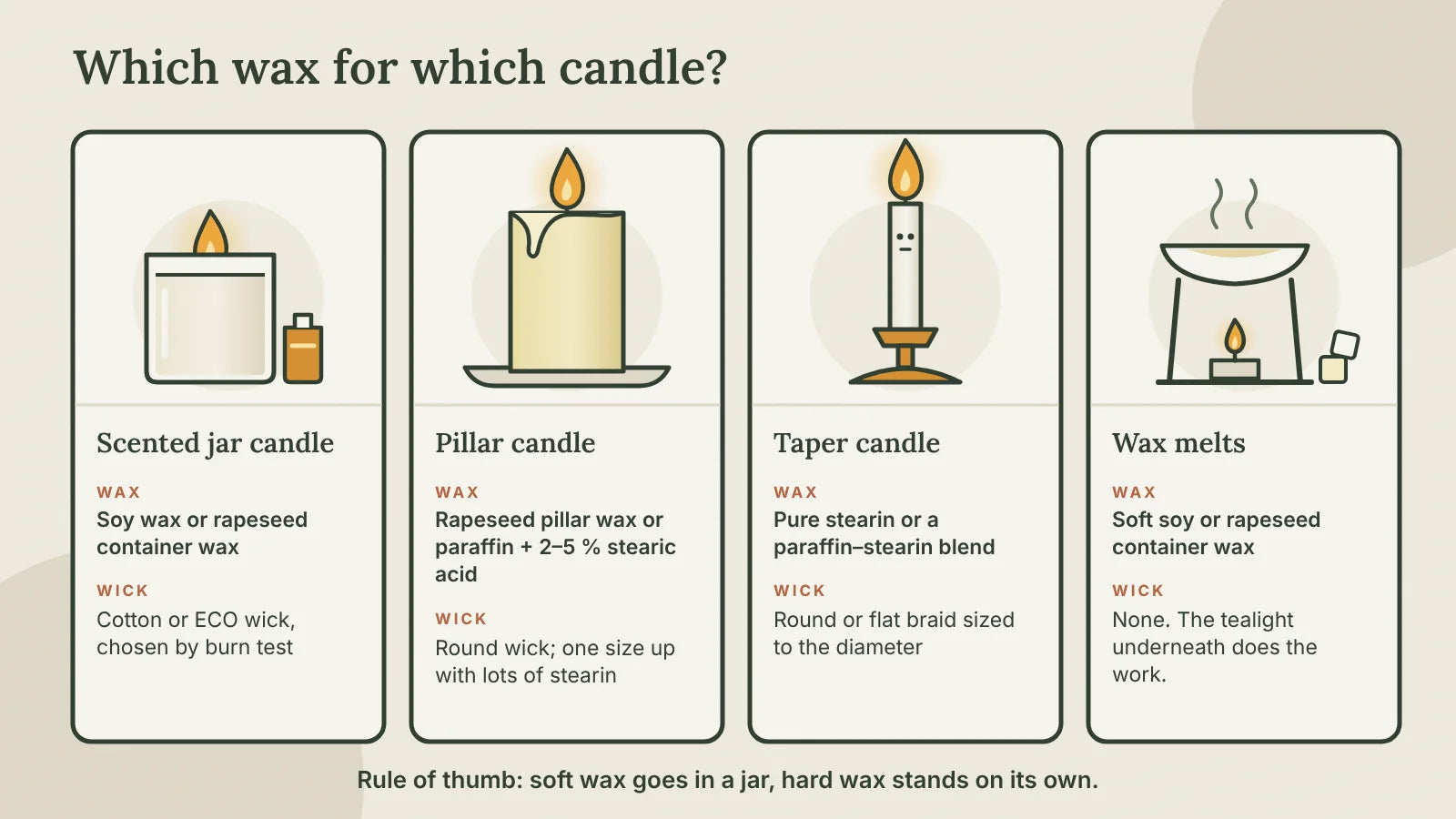
For scented candles in jars, use soy wax or rapeseed container wax; for pillars and tapers, use stearin, rapeseed pillar wax or a paraffin–stearin blend. If sourcing matters to you, rapeseed is grown in Europe while soy is usually imported. Everything else comes down to wick, fragrance load and pour temperature.
In 30 seconds
- Stearin: hard, crystalline, holds its shape. Great for tapers and pillars, wrong for jars.
- Rapeseed wax: comes soft (for containers) and hard (for pillars). A European raw material.
- Soy wax: soft, creamy, takes a good fragrance load. The standard for jar candles.
- Soot and burn quality depend mostly on the wick, not the wax alone. Always run a burn test.
- Stearic acid from Naturcera is a hardener, not a candle wax: 2–5 % in paraffin or plant wax.
What are stearin, rapeseed wax and soy wax?
Stearin is a blend of stearic and palmitic acid made from fats. Candle-grade stearin today comes mostly from palm oil, less often from rapeseed oil or animal fat. In Germany and much of northern Europe it is the traditional dinner and Advent candle, so if you sell there, customers will know it by name.
Rapeseed wax is made by hydrogenating rapeseed oil. Depending on how far it is hydrogenated, you get a soft container wax or a firmer wax for pillars. Rapeseed (canola) is grown widely across Europe.
Soy wax is hydrogenated soybean oil. Most candle grades are soft and built for containers; pillar blends exist, but they are the exception.
Melting point: why it decides between jar and pillar
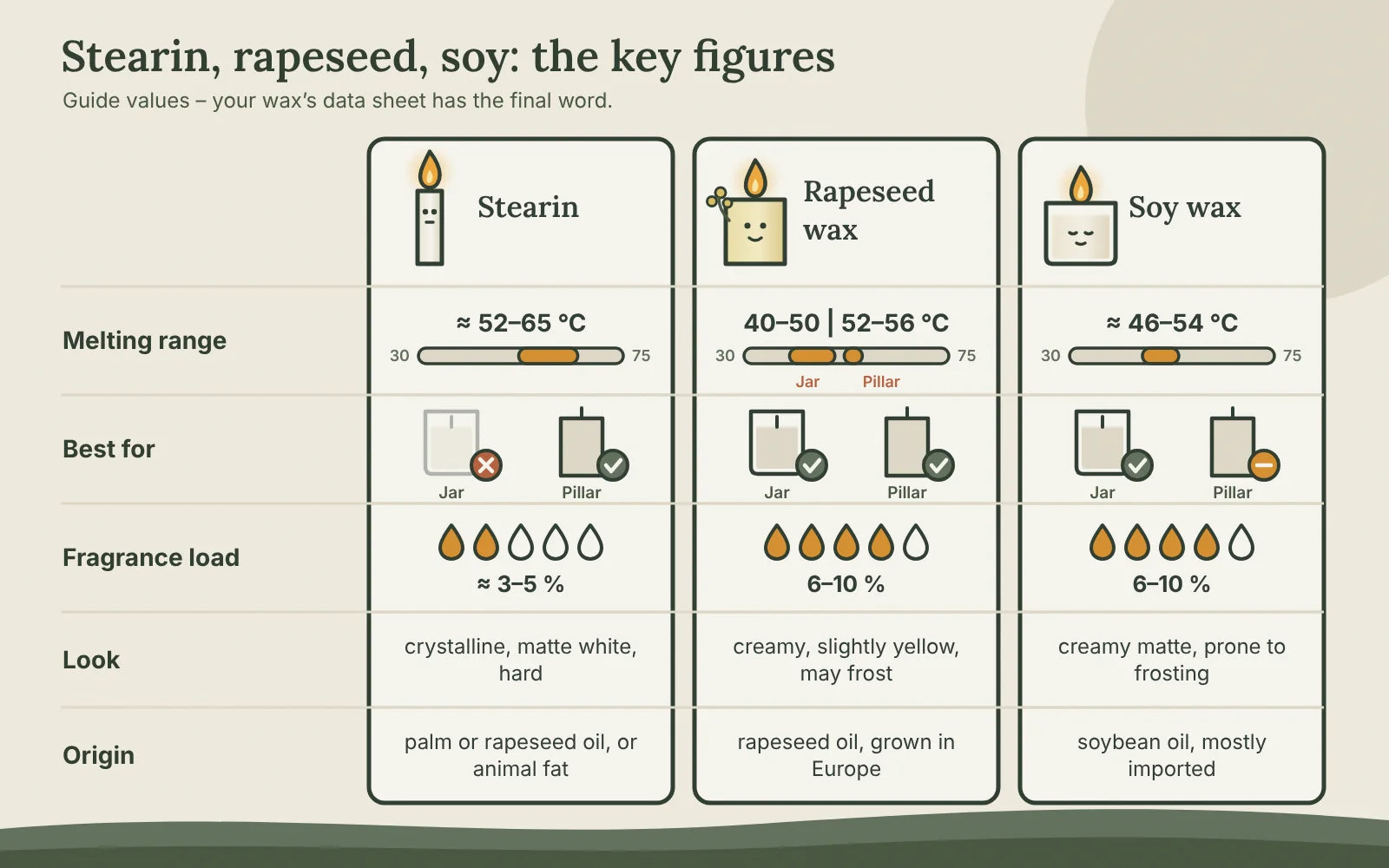
A low melting point means the wax liquefies quickly, sticks to the glass and forms a wide melt pool – exactly what a jar candle needs. A high melting point means the candle stays upright on a warm day, drips little and releases cleanly from the mould.
| Stearin | Rapeseed wax | Soy wax | |
|---|---|---|---|
| Melting range | approx. 52–65 °C, depending on grade | Container: approx. 40–50 °C · Pillar: approx. 52–56 °C | approx. 46–54 °C (container grades at the lower end) |
| Use | Tapers, pillars, moulded candles | Jar or pillar, depending on grade | Jars, wax melts |
| Fragrance load | on the low side, approx. 3–5 % | approx. 6–10 % | approx. 6–10 % |
| Look | matte white, crystalline | creamy, slightly yellow | creamy matte |
| Weak spot | brittle; pulls away from glass | can frost | frosting; soft in summer |
| Origin | mostly palm oil | rapeseed oil, Europe | soybean oil, mostly imported |
Jar or free-standing: which wax for what?
Stearin: the taper and pillar specialist
Stearin is hard and shrinks noticeably as it cools, so it practically drops out of the mould. The same property makes it useless in jars: it pulls away from the glass and leaves air pockets and cracks. Poured on its own it gives the classic, slightly translucent white stearin candle. More often it is used as an additive: paraffin with a small share of stearin is a proven blend for pillars and tapers – the stearin adds hardness and opacity and makes demoulding easier. A note on moulds: stearin can attack rubber and latex moulds; metal and polycarbonate moulds are fine.
Not quite the same thing. Candle stearin is a mix of stearic and palmitic acid. Naturcera sells pure plant-based stearic acid from palm or coconut oil (melting point 54–72 °C depending on grade) – as a hardener, not as the wax for a 100 % stearin candle. The dose is 2–5 % of total weight: 3–5 % in soy pillar wax or soft paraffin, 2–4 % in coconut wax. It makes the candle harder, matte white and easier to demould, and extends burn time. Above 5 % the candle turns brittle. Don’t use it in soy container wax (BPF): the wax pulls away from the glass and cracks.
Rapeseed wax: two grades, two jobs
With rapeseed you need to check what you are buying. Rapeseed container wax is soft, adheres to the glass and burns calmly with a wide melt pool. Rapeseed moulding wax is firmer (Naturcera’s comes as pellets with a 52–56 °C melting point and pours best at about 70 °C), shrinks as it cools and demoulds easily. Mixing them up is the classic beginner mistake: pillar wax in a jar leaves holes and rings; container wax in a mould gives a candle that won’t release or slumps.
Soy wax: the jar specialist
Soy wax is made for scented jar candles: low melting point, creamy surface, good adhesion and good hot throw. Standard soy is too soft for free-standing candles; dedicated pillar blends exist but are not the norm – at Naturcera that is the mouldable APF soy wax. Soft soy also works well for wax melts.
Fragrance, finish and frosting
Fragrance load. Soy and rapeseed wax typically take 6–10 % fragrance oil; the data sheet tells you what your specific wax can hold; for Naturcera’s BPF soy wax it is 8–10 %. Stearin binds fragrance less well and is usually dosed lower. More oil does not mean more throw: overloaded wax sweats and can soot.
Frosting. Plant waxes develop fine white crystals on the surface or against the glass over time. It is purely cosmetic, not a quality defect. You get less of it with pre-warmed jars, a pour temperature that isn’t too hot and slow cooling away from draughts.
Stearin crystals. With stearin, crystallisation is part of the appeal: depending on pour and mould temperature you get a smooth surface or a visible, frost-like crystal pattern. If you want a consistent look, note your temperatures and keep them steady.
Burn and soot: what really matters
All three burn cleanly when the wick matches the candle diameter. The usual causes of soot are a wick that is too large, an untrimmed wick (trim to about 5 mm before each lighting), draughts and too much fragrance. Stearin candles drip little thanks to their higher melting point. With soy and rapeseed jar candles the typical problem is the opposite: an undersized wick that tunnels.
Which wick suits which wax?
- Soy and rapeseed container wax: plant waxes are more viscous than paraffin and often need a slightly stronger wick. Cotton wicks and ECO wicks with a cellulose core work well; they stand straight and burn evenly.
- Rapeseed or paraffin–stearin pillars: braided round or flat wicks chosen by candle diameter. The more stearin, the more likely you need one size up.
- Stearin tapers: flat or round braid sized to the diameter; stearin usually needs a slightly larger wick than paraffin of the same size.
- Always test: burn for at least three to four hours and check that the melt pool reaches the edge, the flame stays steady and nothing soots.
Sustainability and price
All three are renewable, biodegradable raw materials; the difference is where they come from. Rapeseed grows in Europe, often a few hundred kilometres from the workshop. Soy is mostly imported from North and South America, so it is worth asking about origin and certification. Stearin mostly comes from palm oil; if you use it, look for certified material (e.g. RSPO) or rapeseed-based stearin.
Price-wise they are closer than many expect. That said, rapeseed wax costs more per kilo than soy. At Naturcera, BPF soy wax drops with volume from €6.50/kg (1 kg) to €3.55/kg from 500 kg (October 2026). Blending with paraffin lowers material cost per candle.
In small-batch production, repeatability matters as much as the wax itself: same batch, same pour and room temperature, same wick. Naturcera supplies soy, rapeseed and paraffin waxes from about 1 kg to several hundred kilos with volume pricing and data sheets; orders over 500 kg are handled directly by the sales team (contacto@naturcera.com). Plant-based stearic acid as a hardener is available from 1 kg to 800 kg.
Frequently asked questions
Can I pour stearin into a jar?
Better not. Stearin shrinks a lot as it cools and pulls away from the glass, leaving air pockets and an uneven burn. For jars, use soy wax or rapeseed container wax.
Why does my soy candle have white patches?
That is frosting: crystallisation that is normal in plant waxes. Pre-warmed jars, a moderate pour temperature and slow cooling reduce it. It does not affect the burn.
Can I blend rapeseed and soy wax?
Yes, both are hydrogenated vegetable oils and get along. Only blend grades with the same purpose (container with container) and run a burn test before a production batch.
Which wax produces the least soot?
With the right wick, all three burn with little soot. Soot comes mainly from oversized or untrimmed wicks, draughts and too much fragrance – not from choosing stearin, rapeseed or soy.
Does Naturcera sell stearin?
Naturcera sells plant-based stearic acid from palm or coconut oil, not candle stearin as a blend. It is meant as a hardener: 2–5 % in paraffin or plant wax, not for soy container wax (BPF).
Plant waxes for your candles
Rapeseed and soy wax for jars and pillars, with data sheets and prices from 1 kg.
