

To make a massage candle, combine a low-melting plant wax with a butter and a liquid oil, and add very little scent. You burn it for a few minutes, blow it out and use the pool of melted wax as a warm massage oil. A reliable base recipe is 70 % wax (soy 46, coconut or a blend of both), 15 % shea butter, 14 % vegetable oil and 1 % essential oils.
In 30 seconds
- Use a low-melting wax. Soy wax 46 melts at 45–47 °C and coconut wax at 33–35 °C. Pillar waxes won't work.
- Start from 70 % wax, 15 % butter, 14 % oil and 1 % essential oils, with essential oils at 2 % at most.
- Leave out candle fragrance oils and candle dyes. This goes on skin.
- Always blow it out before use and test a few drops on the inside of your wrist. It should feel warm, never hot.
- Once you sell it, it's a cosmetic product and needs a safety assessment under Regulation (EC) 1223/2009.
Which wax for a massage candle?
Melting point decides everything. The lower the temperature at which a wax turns liquid, the sooner you get a melt pool and the less heat that oil carries to the skin. That's why pillar waxes, hard paraffins and pure beeswax are out: they melt too high.
Two waxes in our range are suited to this, and both data sheets list massage candles as a use:
- Soy wax 46. Partially hydrogenated soy flakes, melting at 45–47 °C. It gives a firm candle that survives shipping and summer.
- Coconut wax. Fully hydrogenated plant wax melting at 33–35 °C, close to skin temperature. It melts almost at once and feels very silky. The downside is that it softens in summer, and the data sheet warns it may arrive melted. Sold from 20 kg.
Blending the two lets you tune the texture. More soy gives a firmer candle and more coconut gives a creamier one.
The recipe: percentages by weight
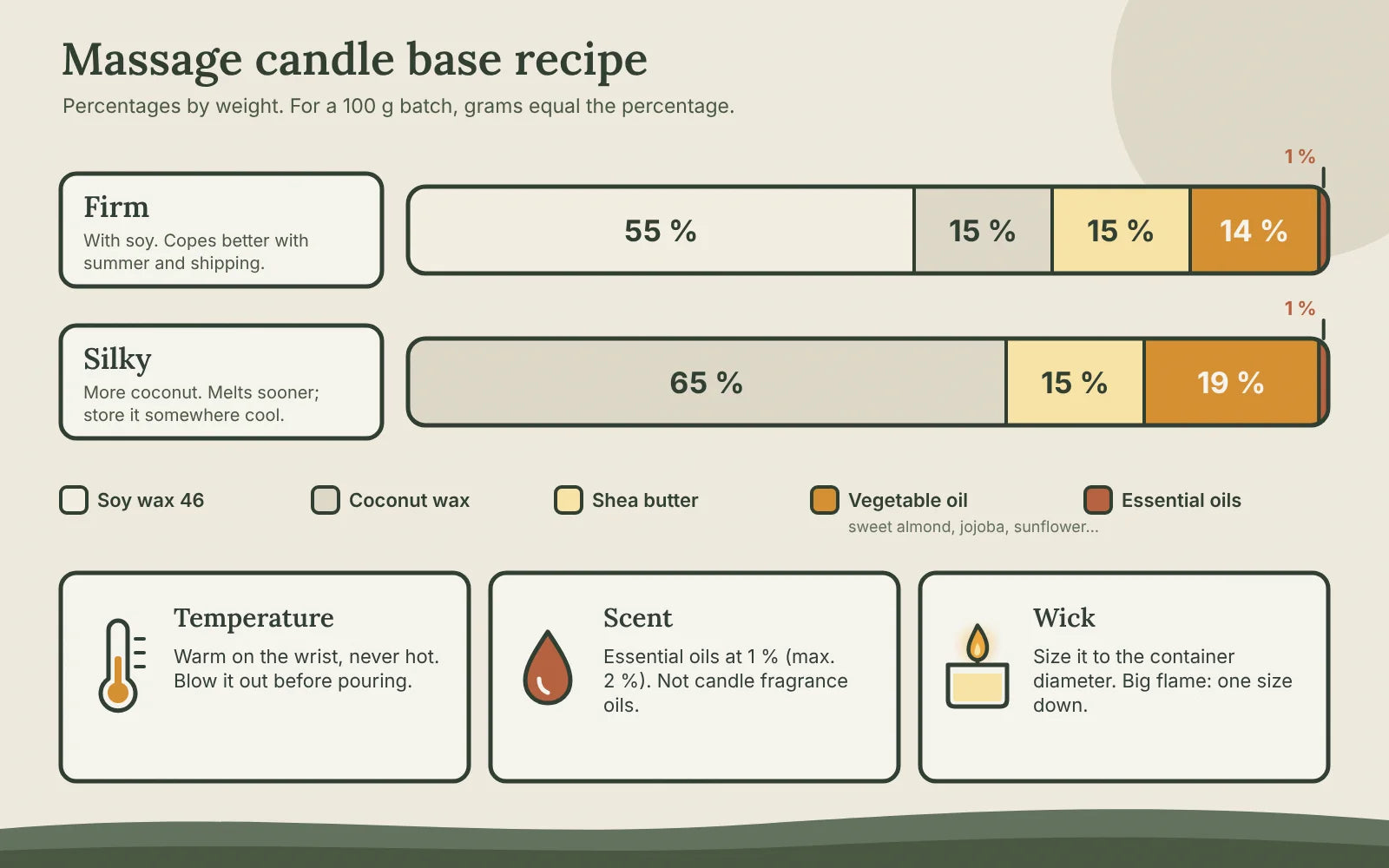
| Ingredient | Firm | Soy only | Silky |
|---|---|---|---|
| Soy wax 46 | 55 % | 70 % | — |
| Coconut wax | 15 % | — | 65 % |
| Shea butter | 15 % | 15 % | 15 % |
| Liquid vegetable oil | 14 % | 14 % | 19 % |
| Essential oils | 1 % | 1 % | 1 % |
| Best for | Selling, shipping, summer | Small batches without buying coconut wax | Home use in winter |
Shea butter adds body and leaves skin soft. You can use cocoa butter instead, which is harder and smells of chocolate, or mango butter, which is lighter. The liquid oil controls how runny the pool is. Sweet almond, jojoba, high-oleic sunflower and grapeseed all work. To slow rancidity, add 0.5 % vitamin E (tocopherol) and reduce the oil by the same amount. Every butter and oil should be cosmetic grade.
Too hard? Raise the oil by 5 points and lower the wax by the same. Sweating or soft at room temperature? Do the reverse. Change one thing per test batch.
Which scent to use, and which not to
This is where most recipes go wrong. Candle fragrance oils are formulated and documented for burning. Their IFRA certificate and data sheet cover candles, not a product that stays on skin. Naturcera's fragrances come with candle documentation, so we don't recommend them for massage candles.
- Use cosmetic-grade essential oils at 1 % of the total weight, 2 % at most. For a 100 g batch that's 1 g, weighed rather than counted in drops, because drop size varies from bottle to bottle.
- Lavender, sweet orange and frankincense are the gentlest place to start. Avoid cinnamon, clove and lemongrass, which can irritate even at low doses. If the skin will see sun, avoid cold-pressed bergamot, lime and lemon too, because they are phototoxic.
- An unscented candle is a perfectly good massage candle. Leave essential oils out for sensitive skin, pregnancy and children.
Candle dyes aren't cosmetic ingredients and can stain skin and fabric. Massage candles stay their natural white or ivory.
How to make a massage candle, step by step
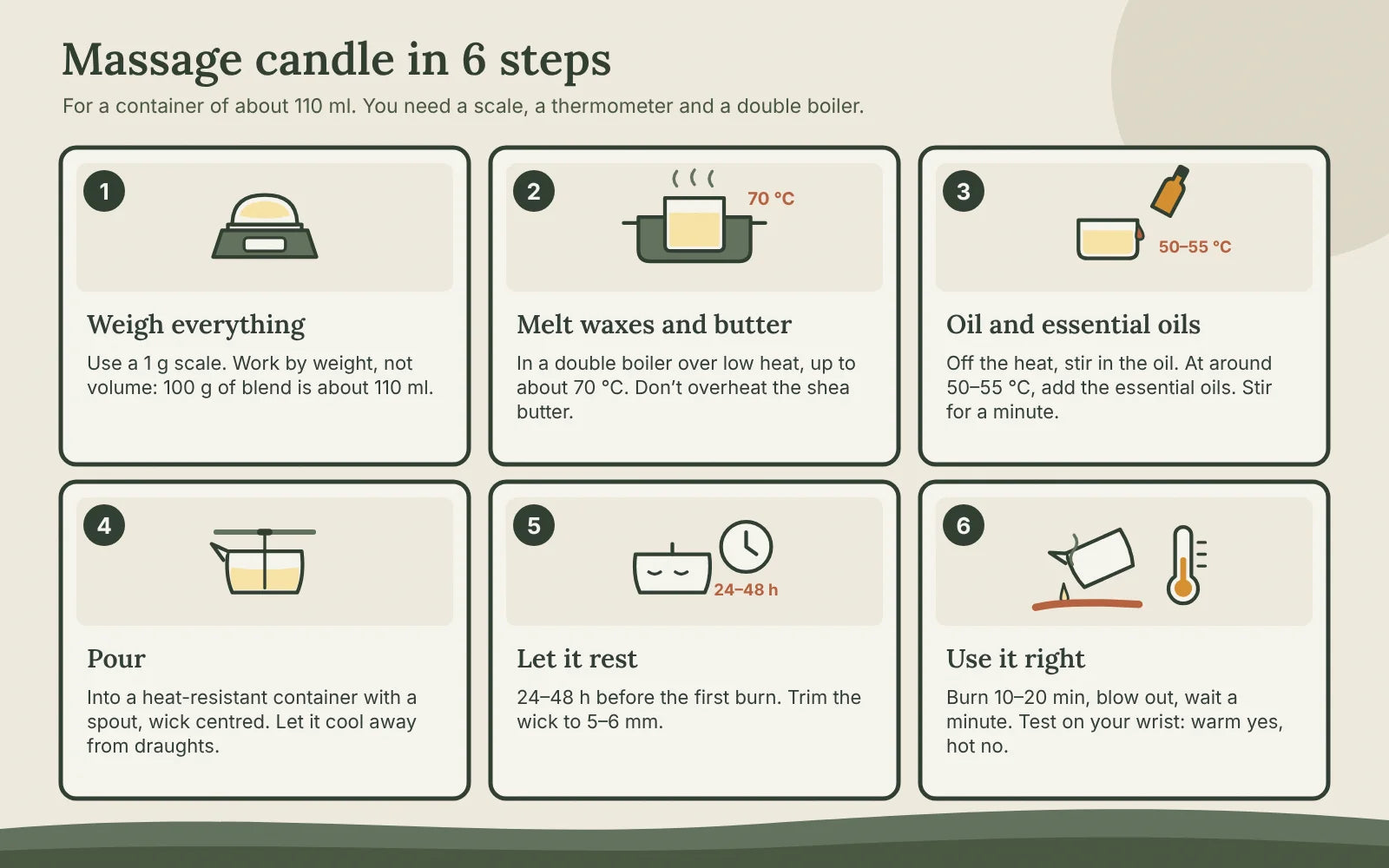
- Weigh. Use a scale that reads to 1 g and weigh everything. 100 g of blend fills about 110 ml.
- Melt the waxes and butter in a double boiler over low heat, up to about 70 °C. Don't leave shea butter on the heat too long, because if it overheats and then cools slowly it can turn grainy.
- Take it off the heat and stir in the oil. At 50–55 °C, add the essential oils and stir gently for a minute.
- Pour into the container with the wick already centred and held by a wick centring bar. A long-spout pouring jug keeps things tidy. Let it cool away from draughts.
- Let it rest for 24–48 hours before the first burn. Trim the wick to 5–6 mm.
- Use it right. Burn for 10–20 minutes, blow out, wait a minute and test a few drops on the inside of your wrist.
How hot does it get on the skin?
With these waxes, the pool of a freshly extinguished candle is hot but cools fast once spread. Skin starts to read heat as burning at around 43–45 °C, so the rule is simple: blow it out, wait, and always test on your wrist. If it stings, wait longer. Never pour wax straight onto someone's skin from above. Pour it into your palm first and apply from there. Keep it away from the face, mucous membranes and broken or irritated skin.
Wick and container
A massage candle needs a small, calm flame rather than a big pool. Size the wick to the inside diameter of the container. Our ECO and cotton wicks are sold by diameter range. These blends melt very quickly, so if the flame runs tall or the pool gets deep within minutes, drop one size. The full method is in our wick selection guide.
The container should be heat resistant, wide mouthed and stable, ideally with a pouring spout. Glazed ceramic and thick glass work well, while tins get hotter to the touch. With a spoutless glass jar, scoop the melted wax with a wooden spatula.
Storage
Keep it covered, away from light and heat. The coconut-rich version softens above about 30 °C. The wax isn't what spoils first. The oil and butter go rancid over time, and if it smells rancid, it no longer belongs on skin. Wipe any oil off the rim before relighting.
What if I want to sell them?
A massage candle is applied to the skin, so in the EU it's a cosmetic product under Regulation (EC) 1223/2009. Selling one requires several things:
- an EU-based responsible person
- a safety report signed by a qualified assessor
- a product information file
- notification on the CPNP portal
- cosmetic labelling with an INCI list
Regulated allergens in the essential oils must also be declared above the legal thresholds. Some countries add their own rules, such as registering the manufacturing site. Because it's also a candle, it needs safe-use warnings as well. Our article on candle sales legislation covers that part. None of this applies to gifts or home use. For sales, there are no shortcuts.
Coconut wax comes in 20 to 500 kg formats, from €6.90/kg down to €6.20/kg. For larger quantities, or for the wax's technical and safety data sheets for your cosmetic file, write to contacto@naturcera.com. If you already formulate creams, see our natural cosmetics basics.
FAQ
Can I use any soy wax for a massage candle?
No. You need a low-melting wax such as soy 46 (45–47 °C) or coconut wax (33–35 °C). Standard container soy waxes are made to burn, not to go on skin.
Can I scent it with candle fragrance oil?
We don't recommend it. Its documentation covers candles, not a product that stays on skin. Use cosmetic-grade essential oils at 1 % (2 % at most) or leave it unscented.
How long should it burn before use?
10–20 minutes, until there's enough melted wax. Then blow it out, wait a minute and test on your wrist.
Can I sell homemade massage candles?
Only in line with the EU Cosmetics Regulation (EC) 1223/2009. That means a responsible person, a safety assessment, a product information file, CPNP notification and INCI labelling.
How long does a massage candle keep?
Until the oil or butter turns rancid, which depends mainly on the oil. Store it covered somewhere cool and dark, and throw it out if it smells off.
Coconut wax for candles
Fully hydrogenated, melting at 33–35 °C. For massage candles and container blends.
