

The white patches on soy candles are called frosting: the wax itself recrystallises into a more stable form that scatters light like frost. It is not dirt, damp or a quality defect, and the candle burns and smells exactly the same. You can reduce it a lot by controlling pour temperature and cooling, but with 100% soy you cannot get rid of it completely.
In 30 seconds
- Frosting is crystallisation of plant wax: the crystals shift to a larger, whiter form. Chocolate does the same thing (it is called bloom).
- It is cosmetic. It does not change the burn, the scent throw or the safety of the candle.
- Fast cooling, temperature swings in storage, dark colours and 100% soy all make it worse.
- To reduce it: preheated jars, the same pour temperature every batch, slow cooling at 20-22 °C and a heat gun over the top.
- If you sell candles, explain it on the product page before customers ask.
For this guide, start with soy waxes that fit the final application, then validate the complete formula in a small test before scaling.
What soy candle frosting actually is
Soy wax is hydrogenated soybean oil: a mix of triglycerides, like any fat. Solid fats can crystallise in more than one form, which is called polymorphism. When it cools quickly, the wax first forms small, unstable crystals. Over days and weeks some of them rearrange into a more stable form with bigger crystals. Those scatter light differently and show up as a white haze, sometimes in flower or feather shapes.
That is why frosting usually turns up later rather than straight away: a flawless candle on Monday can be frosted by Friday. It is also why you see it most on the sides of a clear jar, where the wax meets the glass, and on the top.
Is it a defect? Does it affect the burn?
No. The wax has the same composition with or without white crystals. The wick draws up the same fuel, the melt pool forms the same way and the fragrance is released the same way. It is a trait of natural waxes, like the grain in wood. What does matter is not to confuse it with lookalike problems that do have a fix:
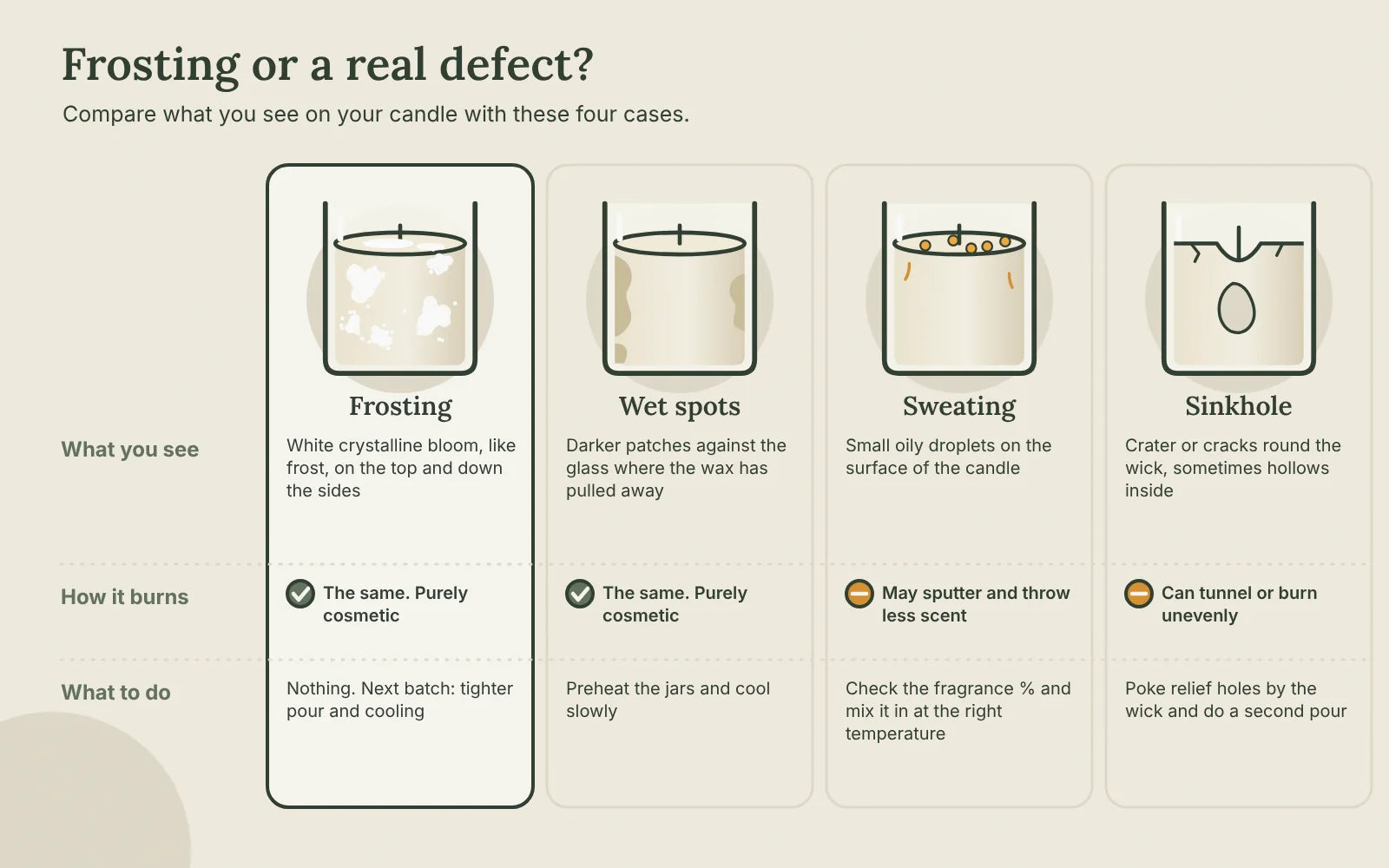
Wet spots (darker patches against the jar) are wax that has pulled away from the glass, not crystallisation. Sweating (oily droplets on top) points to fragrance that was not mixed in properly or too much of it. If you are looking at a hole or a crack, the cause is wax shrinkage, not frosting.
Why it happens: what makes frosting worse
No single thing causes it. It is the sum of how the wax cooled and what has happened to it since.
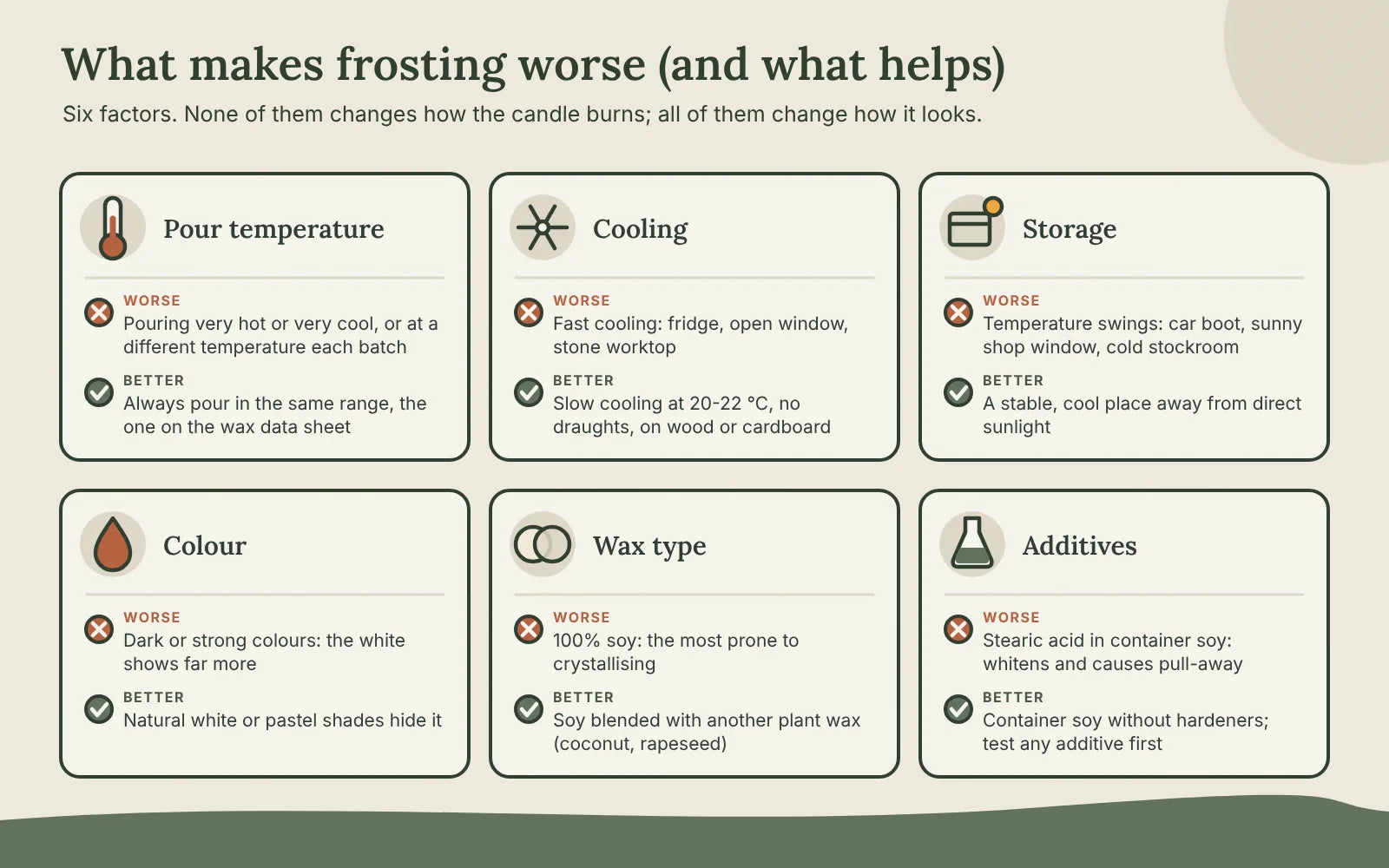
| Factor | What happens | What to do |
|---|---|---|
| Pour temperature | Too hot or too cool, the wax crystallises unevenly. If every batch goes in at a different temperature, every batch looks different. | Pick one temperature and always check it with a thermometer. |
| Cooling | Fridge, open window or stone worktop: the wax sets fast and in patches. | Cool at 20-22 °C, out of draughts, candles spaced apart on wood, cardboard or a wire rack. |
| Storage | Cycles of cold and warm (car boot, sunny shop window, unheated stockroom) grow the crystals. | Store somewhere stable, cool and out of direct sun. |
| Colour | It does not cause frosting, but it gives it away: white stands out on greens, blues and blacks. | Light or pastel shades, or accept that a dark soy candle will show some streaks. |
| Wax type | 100% soy is the most prone to crystallising. | Blend with another plant wax, after testing. |
| Additives | Stearic acid whitens the wax and, in container soy, also causes it to pull away from the glass. | Container soy without hardeners. Test any additive in a small batch first. |
How to reduce frosting, step by step
With our BPF soy wax for container candles, this is the process that gives the best finish:
- Melt without overdoing it. To around 70 °C, as the BPF data sheet says. Going much hotter does not help and is hard on the fragrance. There is more detail in our guide to soy wax melting temperature.
- Add the fragrance and stir gently. 8-10% of the wax weight, for a couple of minutes, without whisking air in.
- Preheat the jars. A few minutes in the oven at about 40 °C, or a heat gun run round the inside. Cold glass chills the wax suddenly, exactly where it shows most.
- Pour at the same temperature every time. Many container soy waxes are poured between 50 and 60 °C. Test within that range, note which gives you the best finish and repeat it every batch.
- Cool slowly. A room at 20-22 °C with no fans or air conditioning, about 10 cm between candles, on wood, cardboard or a rack, never on marble or metal.
- Finish the top. A quick pass with a hot air gun melts a couple of millimetres and leaves the surface smooth. It also works on a candle that has already frosted on top.
Wax blends: the longer-term fix
Adding some of another plant wax changes the way soy crystallises and softens the frosting. Coconut wax is very soft (it melts at 33-35 °C), so it goes in at small proportions: start at 10-20% and burn test, because a blend may need a different wick. No blend guarantees zero frosting, but you will get less of it and more evenly spread.
If frosting on the sides bothers you, use opaque, amber or coloured jars. Heat fixes the top of the candle; it cannot fix the side of a clear jar.
How to explain it to customers if you sell candles
Someone who buys a soy candle with white patches assumes it is old, dirty or badly made, and they get in touch. Getting there first works much better:
- On the product page: “Our candles are made with soy wax. As a natural wax, it can develop a white crystalline bloom over time (frosting). It does not affect how the candle burns or smells: it is simply a characteristic of plant wax.”
- On the card in the parcel: a shorter version of the same line, with a photo of a frosted candle so people recognise it.
- In your photos: shoot candles that are a few weeks old, not fresh ones. If the listing shows a flawless candle and the one that arrives does not look like it, the customer feels short-changed.
Across hundreds of candles, frosting stops being a candle problem and becomes a process one: log the pour temperature and room temperature for each batch, preheat jars by the tray and keep stock somewhere with a steady temperature. If you work with several hundred kilos of soy wax, email contacto@naturcera.com for volume pricing.
Frequently asked questions
Does frosting mean the wax is poor quality?
No. It happens with any soy wax, including the best. It is a trait of plant waxes, which is why you hardly ever see it on a paraffin candle.
Can I remove frosting from a finished candle?
From the top, yes: a pass with a heat gun leaves it smooth. From the sides of a jar, not in any practical way. It can also come back over time.
Does it affect scent throw or burning?
No. The wax is the same; only the crystal form changes. The candle burns and scents the room just as well.
Why is it worse on coloured candles?
The dye does not cause it, but white contrasts much more against a dark or strong colour. On light shades it is barely noticeable.
Can I prevent it completely?
With 100% soy, not completely. Preheated jars, a consistent pour temperature, slow cooling and a blend with another plant wax reduce it a lot.
Materials for this project
For this guide, start with soy waxes that fit the final application, then validate the complete formula in a small test before scaling.
