

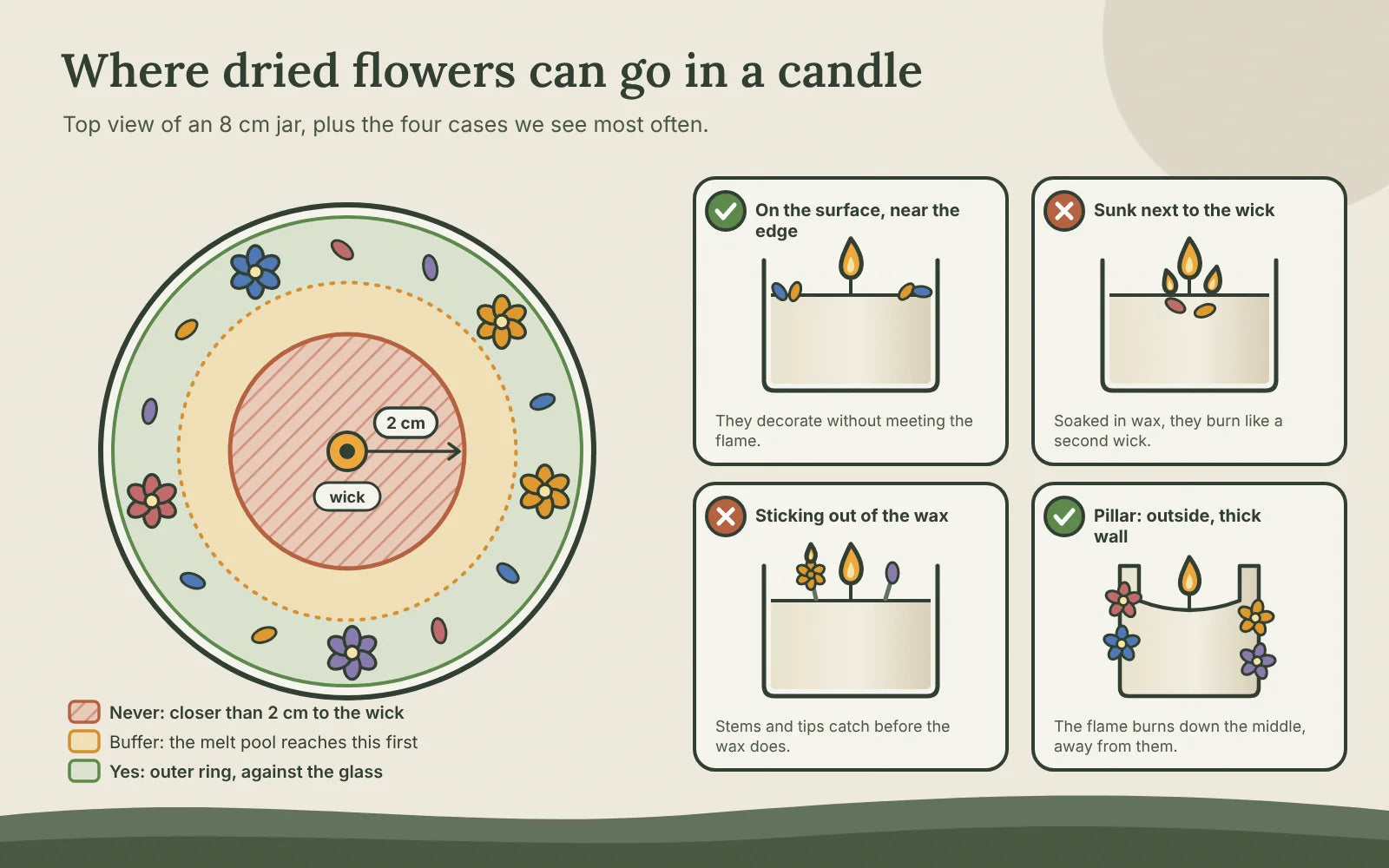
You can put dried flowers on a candle safely as long as they stay where the flame can't reach: on the surface, against the edge of the jar and at least 2 cm from the wick, or pressed onto the outside of a wide pillar. What you never do is sink them near the wick or let them stick out, because a flower soaked in wax burns like a second wick.
In 30 seconds
- Surface only, in the outer ring, 2 cm or more from the wick. Nothing sunk, nothing sticking out.
- Add them once the wax starts to skin over, so they neither sink nor sit loose.
- Small, fully dried petals and blooms: cornflower, calendula, rose, lavender. No long stems, no fresh flowers.
- When burning, once the melt pool nears the flowers, put the candle out and lift them off with tweezers.
- If you sell them: a full burn test and a specific warning on the label.
Is it safe to put dried flowers in a candle?
It depends on where they are. A dried flower is fuel, and once molten wax soaks into it, it behaves like a wick: it draws wax up and holds a flame of its own. That's a secondary wick, and it's why the US National Candle Association (NCA) warned that candles with botanicals embedded near the flame can be a fire hazard. Metal and stone don't have that problem; flowers, leaves, wood and spices do.
The working rule is simple: plant decoration has to stay out of reach of the flame and the melt pool during normal use.
Where to place the flowers: safe and no-go zones
| Placement | Safe? | Why |
|---|---|---|
| On the surface, in the outer ring against the glass | Yes | They decorate without meeting the flame. The melt pool takes a while to get there and you can remove them first. |
| On the outside of a wide pillar | Yes, with the right wick | The flame burns down the middle and leaves an unmelted wall. |
| Sunk next to the wick | No | They soak up wax and burn: a secondary wick. |
| Sticking out of the wax (stems, sprigs) | No | The dry, exposed part catches before the wax even melts. |
| Mixed through the whole candle | No | Sooner or later they surface next to the wick. |
In an 8 cm jar that leaves a ring of just 1–2 cm against the glass. Below 6 cm the margin is so narrow that it's better to decorate the outside (label, lid, twine) rather than the wax.
Which dried flowers to use
Petals and small, flat flowers that settle on the wax without sticking up work best. They must be bone dry: a fresh flower carries water, which in wax means spots, mould and spitting.
| Flower | Look on the candle | Notes |
|---|---|---|
| Blue cornflower | Fine, intense blue petals, striking on white wax | Light: a little goes a long way. |
| Calendula | Warm orange-yellow | Pairs well with citrus and autumn fragrances. |
| Red rose | Large, deep red petals | Use in pieces: one whole petal covers a lot of surface. |
| Lavender | Small purple buds | Rubbed off the stem, not whole sprigs. |
| Hibiscus | Deep burgundy | Can bleed colour into the wax; test first. |
Our petals are dehydrated with no added colour or fragrance, so they won't change how the candle smells. Dried spices and peel (cinnamon, star anise, orange) follow exactly the same rules: they burn too.
How to make a dried flower candle, step by step
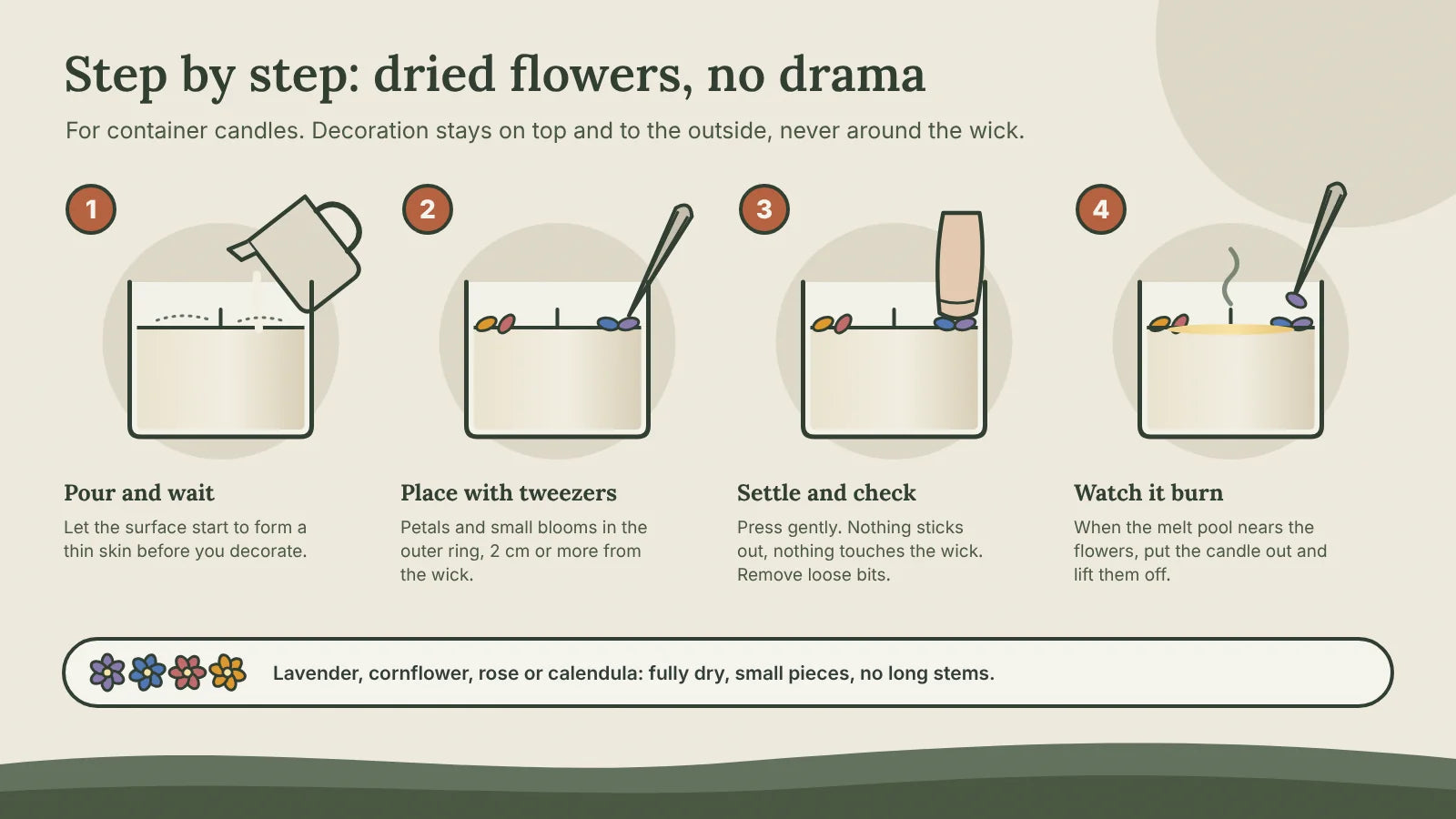
- Make the candle as usual. A container wax such as our BPF soy wax, fragrance and a centred wick. Pick the right wick for the diameter, not a bigger one: an oversized melt pool reaches the flowers sooner. If in doubt, see how to choose candle wicks.
- Pour and wait. Flowers added to very runny wax sink and drift towards the centre. Wait until the surface starts to form a thin skin.
- Place with tweezers. Petals and small blooms in the outer ring, 2 cm or more from the wick. Less is more.
- Settle and check. Press gently so they hold. Nothing should stick out or touch the wick. Remove loose bits.
- If the top looks rough, a quick pass with a heat gun smooths it. Quick: melt too much and the flowers move.
Pillar candles: flowers on the outside
On a pillar or moulded candle (for example with APF mouldable soy wax) the flowers go on the outer wall: use pressed, flat flowers and fix them by pressing with the back of a warm spoon. For this to work the pillar must be wide and the wick must burn down the centre, leaving an unmelted wall. If the wall thins out near the flowers during the burn test, the wick is too big.
Never leave a flower candle burning unattended. When the melt pool approaches the flowers, put the candle out, lift them off with tweezers and relight. If a flower does catch, smother the candle; never use water.
If you sell dried flower candles
A candle sold in the EU must be safe under normal, foreseeable use (General Product Safety Regulation, GPSR). Candles also have specific European standards: EN 15493 covers fire safety and EN 15494 the safety warnings on the label. With flowers, that means:
- A full burn test of the candle exactly as sold, start to finish over several sessions, watching what happens when the melt pool reaches the decoration.
- A specific warning on the label or packaging: "Remove the flowers before the melted wax reaches them. Never leave a burning candle unattended."
- A fixed recipe: same amount of flowers, same placement, same wick. Change anything and you test again.
The rest of the obligations are in our guide to candle selling regulations. And there's one product that sidesteps the issue entirely: scented wax sachets with flowers, which have no wick and are never lit.
Product photos
Photograph the candle unlit to show off the decoration. If you show it burning, keep the flame small and the flowers well away: a shot of petals ringing the flame contradicts your own warning and teaches people to use it wrong. Soft side light and a neutral background do the rest.
Weigh the decoration per candle (with petals, a few grams is plenty) and use a template or a ring cut to the jar size to mark the outer zone, so every unit comes out the same and one burn test covers the whole batch. For regular orders, write to contacto@naturcera.com.
Frequently asked questions
How far from the wick should dried flowers be?
At least 2 cm, and always in the outer ring against the edge of the jar. In jars under 6 cm the margin is so narrow that it's better to decorate the outside.
Can I mix dried flowers into the wax?
Better not. Spread through the candle, they eventually surface next to the wick and burn like a second wick. Keep them on the surface or on the outside of a pillar.
When do you add flowers to a candle?
Once the surface starts to form a thin skin. Too early and they sink; too late and they won't stick.
Can I use fresh flowers?
No. They contain water, which causes spots, mould and spitting in wax. Fully dried flowers only.
What do I do with the flowers once the candle is lit?
When the melt pool gets close to them, put the candle out, lift them off with tweezers and relight.
Dried flowers and petals for decorating
Cornflower, calendula, rose and hibiscus in 500 g bags, with no added colour or fragrance, plus cinnamon, star anise and dried citrus peel.
