


A candle is safe to light after about 48 hours, but it will not smell its best until it has cured: roughly 2-3 days for paraffin, 3-7 days for coconut and coconut blends, and 1-2 weeks for soy and rapeseed. If you plan to sell it, a full burn test comes after the cure. Skipping it costs more than waiting.
In 30 seconds
- First 24-48 h: the wax crystallises and hardens. Do not move or lid the candle until it is completely cool.
- After that, the fragrance spreads through the wax and both cold throw and hot throw improve.
- Typical cure times: paraffin 2-3 days, coconut 3-7 days, soy and rapeseed 1-2 weeks. The sniff test has the final word.
- Cure with the lid on, at a steady room temperature, away from sun and fridge.
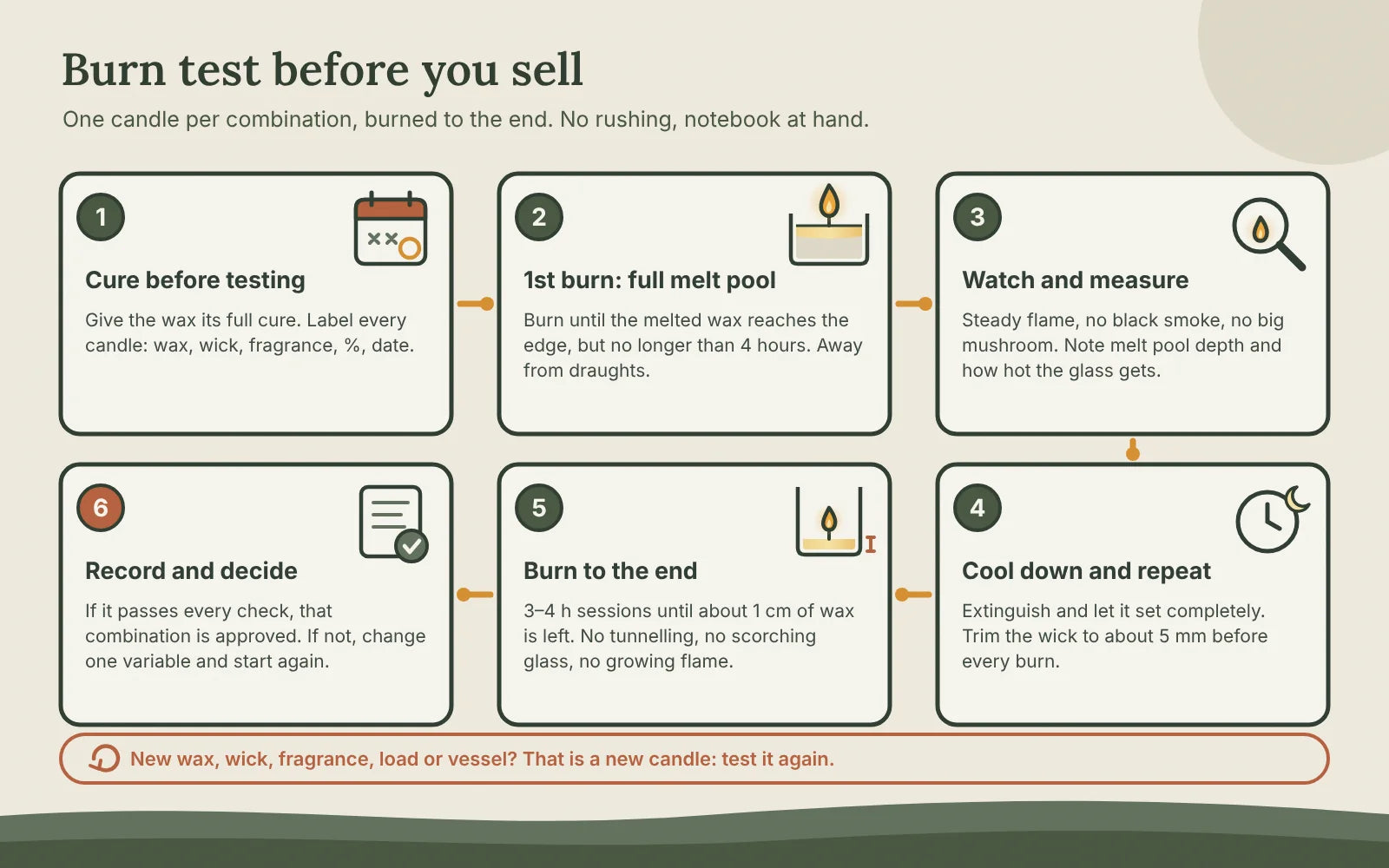
- Before selling: burn one candle of each combination all the way down, in 3-4 hour sessions, with a notebook next to it.
For this guide, start with candle fragrances that fit the final application, then validate the complete formula in a small test before scaling.
What happens while a candle cures
When you pour, the wax is liquid and the fragrance oil is dissolved in it. As it cools, the wax crystallises: it forms a lattice of crystals that traps the fragrance between them. There is no chemical reaction. The fragrance does not "bond" with the wax; it is held in place. This first phase takes about 24-48 hours. After that the structure is stable and the candle burns the same as it will in a month.
What keeps improving is the scent. Over the following days the fragrance becomes more evenly distributed and settles into the crystal structure, and both cold and hot throw get stronger, especially in plant waxes, which crystallise more slowly. Nobody has fully proven the exact mechanism, but anyone who has smelled the same candle at day 2 and day 14 knows the difference.
How long to cure each type of wax
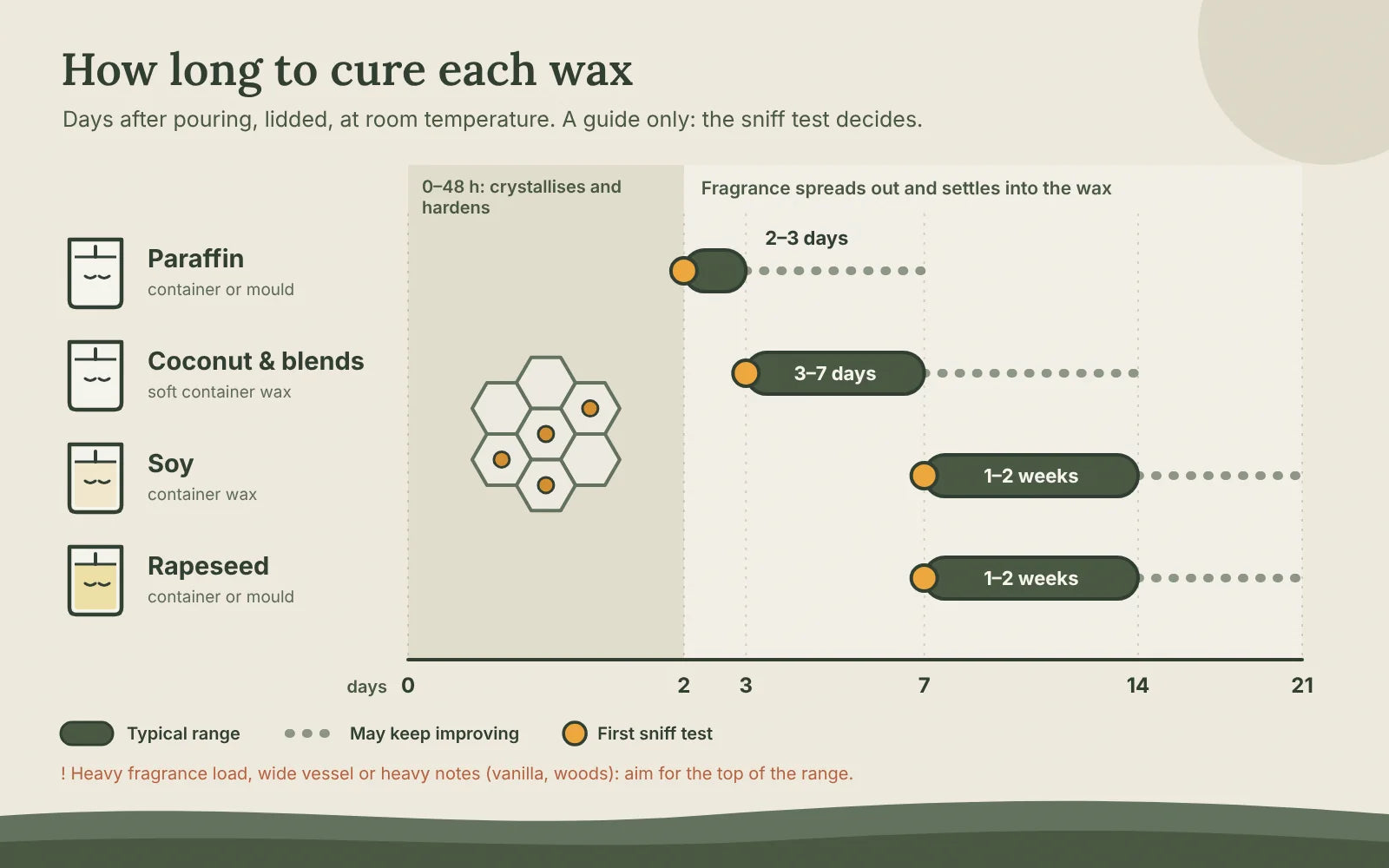
| Wax | First sniff test | Typical cure | Notes |
|---|---|---|---|
| Paraffin | After 48 h | 2-3 days | Crystallises quickly and releases fragrance well from the start. |
| Coconut and blends | After 3 days | 3-7 days | Our coconut wax melts at 33-35 °C, so it is almost always blended and used in containers. |
| Soy | After 7 days | 1-2 weeks | Slow to crystallise and gains the most from curing. |
| Rapeseed | After 7 days | 1-2 weeks | Behaves much like soy. Let it cool away from draughts. |
| Beeswax (unscented) | — | Just let it harden | With no added fragrance, there is no scent to settle. |
What makes curing take longer or shorter
- Fragrance load. Our fragrance oils are used at 6-10 % of the wax weight. Higher loads take longer to settle, and going above the maximum does not add scent: it adds sweating and a worse burn.
- Candle size. A large jar or a three-wick candle needs longer than a 100 g votive.
- Type of notes. Citrus and fresh notes come through early; vanillas, woods and ambers usually need the top end of the range.
- Storage temperature. Heat can make the candle sweat; strong cold can pull the wax away from the glass.
How to store candles while they cure
- Let them cool uncovered. A lid on a warm candle traps condensation on the lid and the surface.
- Lid them as soon as they are cool. Use the lid, cling film or a closed box: fragrance that escapes into the air does not come back.
- Keep the room temperature steady. Away from sun, radiators and windows. No fridge or freezer "to speed things up": sudden changes crack the surface and cause wet spots on the glass.
- Separate by scent. One box per fragrance stops a coffee candle from picking up a hint of lavender.
- Label everything. Pour date, wax, wick, fragrance and load. Without a label, a week later you will not know which is which.
The oven, the fridge and the hairdryer do not shorten the cure. The only thing that speeds up the decision is starting sniff tests early and repeating them.
Cold throw and hot throw tests
Cold throw is how the candle smells unlit, which is what a customer notices in a shop. Hot throw is how it fills a room when lit, which is what decides whether they buy again.
Cold throw
Take the lid off, smell from about 20-30 cm away and score it from 1 to 5. Repeat on day 2, 7 and 14, always in the same spot and, if possible, with the same person. Air the room between candles, or reset your nose with a few coffee beans.
Hot throw
- Use a room of about 10-15 m² with the door closed, free of other scents and air fresheners.
- Burn the candle for 1-2 hours, until the melt pool is close to the edge.
- Step out for 10 minutes to reset your nose, then come back in.
- Note when you notice it: as soon as you open the door, in the middle of the room, or only next to the candle.
If the candle still has a weak scent at the end of its cure range, time is not the problem. Check the temperature at which you added the fragrance, the load and the wick in our guide why a scented candle doesn't smell and how to fix it.
Burn test before you sell
Curing tells you when a candle smells right; the burn test tells you whether it is safe and burns well from the first session to the last. Do it with one candle for each combination of wax, wick, fragrance, load and container.
| What you see | What it usually means | What to try |
|---|---|---|
| Tunnelling: the melt pool never reaches the edge | Wick too small or first burn too short | The next wick size up |
| Tall flame, black smoke, mushrooming wick | Wick too big or too much fragrance | One size down or a lower load |
| Glass very hot to the touch | Wick too big for that container | One size down or a wider container |
| Flame drowns as it goes down | Wick too small or very dense wax | One size up and test again |
| Good cold throw, no hot throw | Small melt pool or an unsuitable fragrance | Review wick and fragrance |
For a starting point on wick size, see our guide how to choose candle wicks.
Work in batches: record each batch's pour date, keep one or two candles as retained samples and sell the oldest stock first once it has cured. Every new combination passes its own burn test before it goes on sale. If you sell in the EU, the reference standards are EN 15493 (fire safety) and EN 15494 (safety labelling). For regular orders of wax and fragrance, write to contacto@naturcera.com.
Frequently asked questions
Can I light a candle before it has cured?
Yes. After about 48 hours, once the wax is fully solid, it burns normally. It just will not smell as strong as it will at the end of the cure.
Does curing for more than two weeks improve the scent?
For most candles the gain after two weeks is small. If it still has little scent at two weeks, review the formula and the wick before you wait any longer.
Should candles cure with the lid on?
Yes, once they are cool. Uncovered, they lose some fragrance to the air and pick up dust and surrounding smells.
Can I speed up curing in the fridge?
No. Sudden cold can crack the surface and pull the wax away from the glass, and it does nothing to help the fragrance settle.
How long does a burn test take?
As long as the candle takes to burn down, in 3-4 hour sessions. For a 200 g candle that means several days, so start it as soon as the cure is done.
Materials for this project
For this guide, start with candle fragrances that fit the final application, then validate the complete formula in a small test before scaling.


