


Coconut wax is a very soft plant wax, and ours melts at 33–35 °C. In candles it's mostly blended with soy, where it smooths and creams the top, cuts down frosting and gets the melt pool going sooner. On its own it only works in container candles kept somewhere cool, or in massage candles. A good place to start is 80 % container soy and 20 % coconut.
In 30 seconds
- Coconut wax is hydrogenated coconut oil. Naturcera's is fully hydrogenated, additive-free and melts at 33–35 °C.
- It's very soft on its own. It softens in summer and may arrive melted.
- Blended into soy at 10–30 %, it gives a smoother top, less frosting and a creamier candle.
- Use up to 7 % fragrance in pure coconut and 7–9 % in soy blends.
- For wicks, size up one range if a soy-heavy blend tunnels, and size down one if a coconut-heavy blend runs a tall flame.
For this guide, start with candle-making materials that fit the final application, then validate the complete formula in a small test before scaling.
What is coconut wax?
Coconut oil is liquid in summer and solid in winter. Hydrogenation saturates its fats and turns it into a soft, creamy wax. Naturcera coconut wax is fully hydrogenated and comes as off-white chunks with no additives or preservatives. It has only a faint coconut smell, so it won't fight your fragrance. Here's what the data sheet says:
| Spec | Naturcera coconut wax |
|---|---|
| Melting point | 33–35 °C |
| Optimal pouring temperature | 50 °C |
| Fragrance or essential oil | Up to 7 % |
| Use | Container candles, scented candles, massage candles |
| Storage | Cool, around 20 °C, out of the sun |
| Pack sizes | 20 to 500 kg |
Plenty of waxes sold as "coconut wax" are really blends of coconut with soy, rapeseed or paraffin. When you compare products, read the composition, not just the name.
What it does in a candle
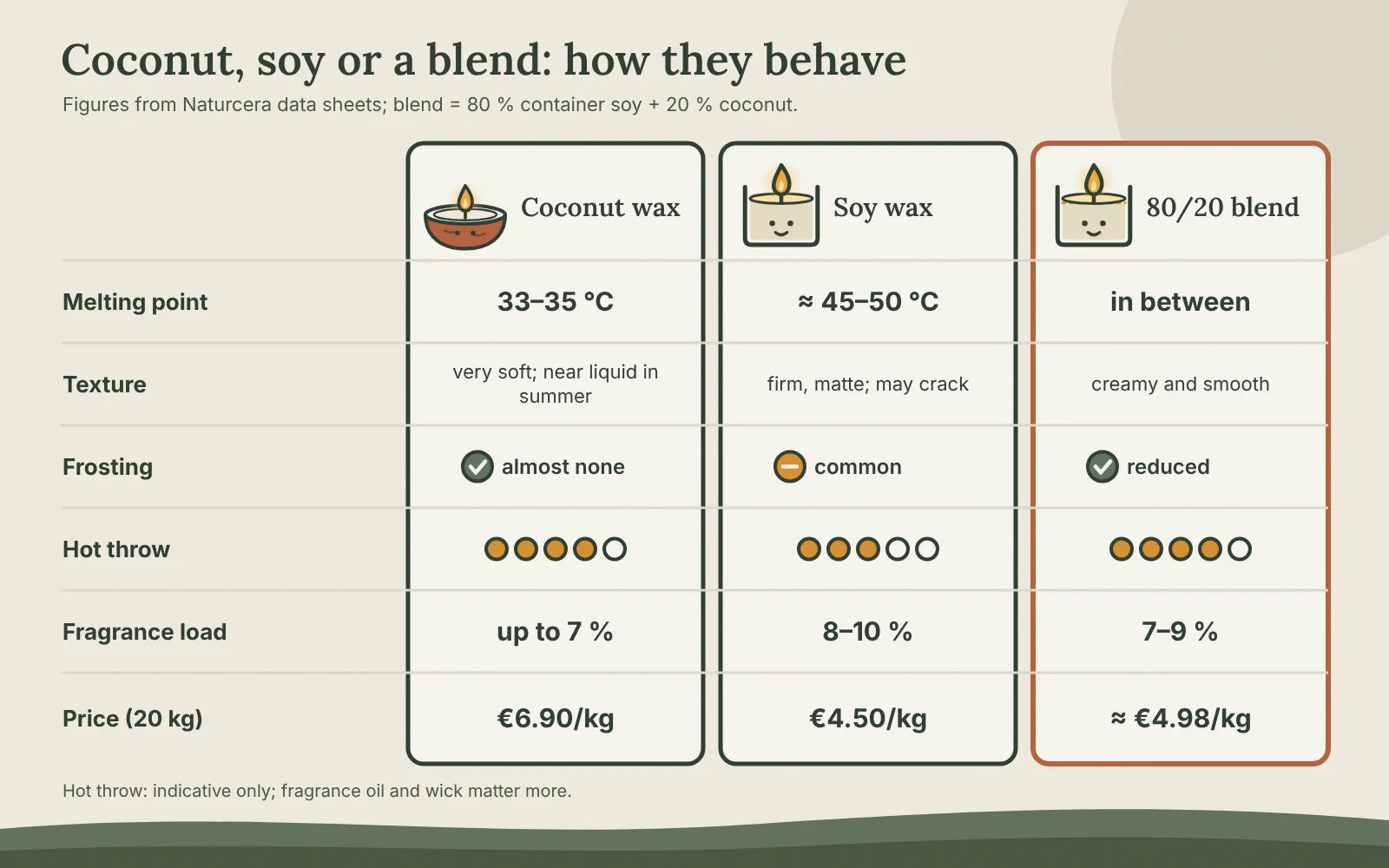
- Smooth, creamy top. Soy tends to set matte and can crack or go lumpy after the first burn. Adding 10–30 % coconut smooths the finish.
- Less frosting. Frosting is the white crystal bloom that appears on soy tops and sides. Coconut won't remove it entirely, but it reduces it a lot.
- Faster melt pool. Because it melts lower, the liquid wax reaches the edge sooner. Many coconut blends give a better hot throw, although the fragrance and wick decide most of that.
- Better glass adhesion. Coconut blends tend to pull away from the jar less than straight soy, so you see fewer of those "wet spots" on the glass.
If frosting is your main issue, check your pouring and cooling temperatures first, as we explain in our soy wax guide. Coconut helps, but it won't fix uneven cooling.
Soy–coconut blends: which ratio?
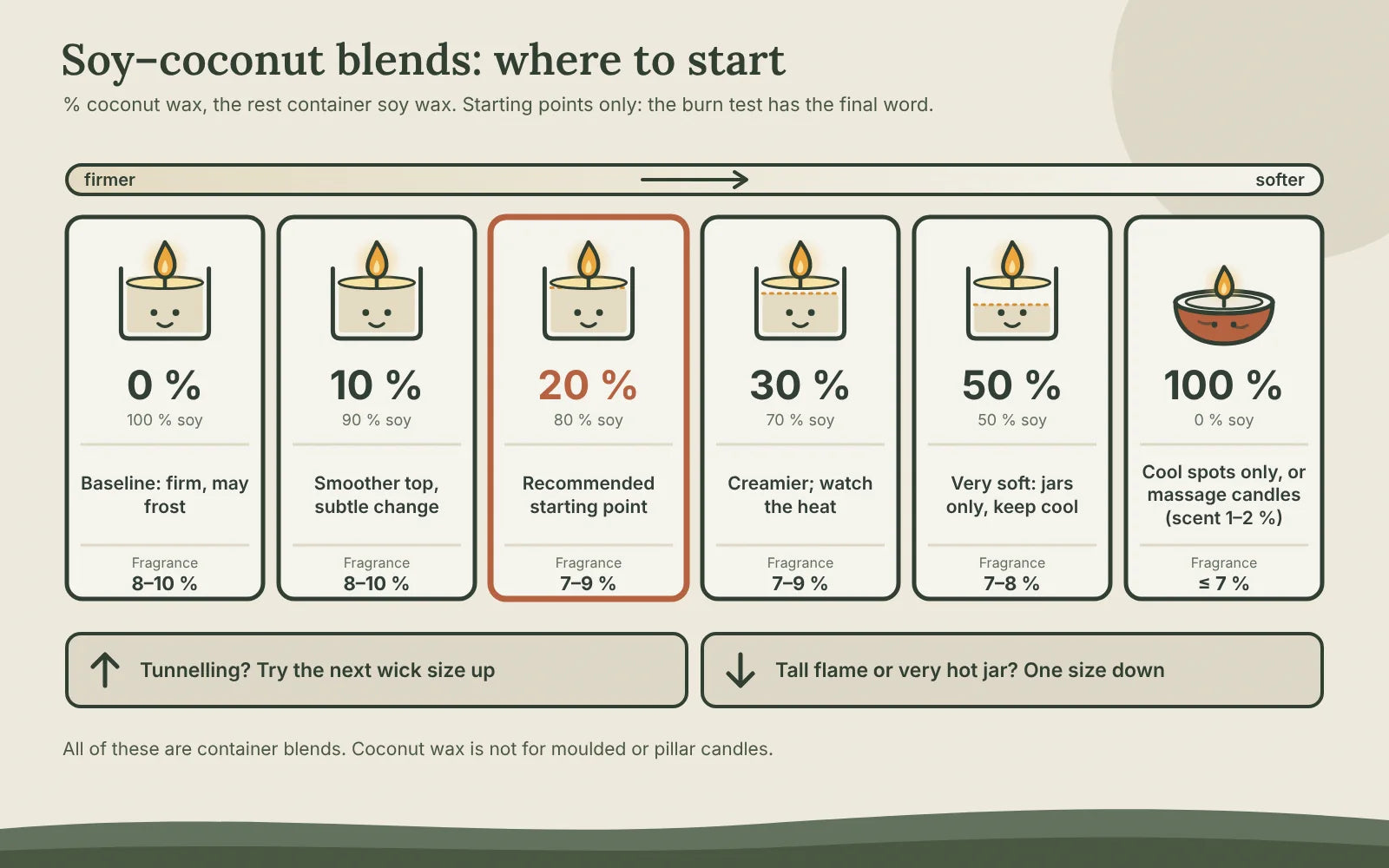
| Coconut / soy | Result | Fragrance | Best for |
|---|---|---|---|
| 0 / 100 | Firm, matte, may frost | 8–10 % | Baseline |
| 10 / 90 | Slightly smoother top | 8–10 % | Better finish, nothing else changes |
| 20 / 80 | Creamy, smooth, less frosting | 7–9 % | Starting point for container candles |
| 30 / 70 | Softer and creamier | 7–9 % | Indoor candles; mind summer shipping |
| 50 / 50 | Very soft, may sweat in heat | 7–8 % | Jars only, kept cool |
| 100 / 0 | Near liquid above 33 °C | Up to 7 % | Massage candles or jars in winter |
To blend, weigh both waxes and melt them together to about 70 °C, the temperature given on the container soy wax (BPF) data sheet. Add the fragrance, stir for two minutes and pour once the blend drops to about 55–60 °C. The more coconut it contains, the closer you can go to coconut's 50 °C pouring temperature. Let the candle cool and set completely before the first test burn.
Pour three identical jars at 10, 20 and 30 % coconut, with the same fragrance and wick, and burn them side by side on the same day. One afternoon will tell you which blend is yours.
How much fragrance does it take?
Our coconut wax data sheet says up to 7 %. Container soy takes 8–10 %, and our candle fragrance oils are designed for 6–10 %. In blends, 7–9 % is a safe range. Going over won't make the candle smell stronger. In a soft wax, excess fragrance ends up as oil droplets on the surface, and the candle "sweats". If the candle doesn't smell at the correct load, the cause is usually elsewhere. Our guide on why a scented candle doesn't smell covers the usual suspects.
Which wick for coconut wax?
Start with the wick for the inside diameter of the jar. Our ECO and cotton wicks are sold by diameter range. Then adjust for the blend:
- Soy-heavy (0–20 % coconut): the wax is dense. If the pool hasn't reached the edge after 2–3 hours and the candle tunnels, try the next range up.
- Coconut-heavy (30–100 %): the wax melts fast. If the flame grows tall, the wick mushrooms or the jar runs too hot, drop one range.
The full table by diameter is in our wick selection guide. The burn test always has the final word.
Container: always a jar candle
At this melting point, coconut wax can't stand on its own, so it's not for pillar or moulded candles. Use it in candle jars or other heat-resistant containers with straight sides. If you want a bit more body in a coconut-heavy candle, the data sheet for our stearic acid recommends 2–4 % for coconut. Don't add it to blends with container soy (BPF), because it encourages pull-away and cracks.
Pros and cons
| Pros | Cons |
|---|---|
| Smooth, creamy top | Very soft: no pillars or moulds |
| Cuts soy frosting | Softens in summer when used alone and may arrive melted |
| Fast melt pool, good hot throw | Takes a little less fragrance (up to 7 %) |
| Very faint own scent | Costs more per kg than soy |
| Plant-based, additive-free | Sold from 20 kg |
How much does it cost?
Coconut wax costs €6.90/kg in the 20 kg pack and drops to €6.20/kg in the 500 kg pack. Container soy is €4.50/kg at 20 kg and €3.55/kg at 500 kg. That puts an 80/20 blend at about €4.98/kg in 20 kg packs and about €4.08/kg in 500 kg packs. In a candle with 180 g of wax, the blend costs about 9 cents more than straight soy. For that, you get a top that comes out right first time.
Both waxes ship in quantities up to 500 kg per order. Above that, or if you want a consistent blend across your whole range, write to contacto@naturcera.com for a quote. In summer, plan coconut orders ahead because it can arrive melted. Let it set and use it as normal, but store it below 25 °C.
FAQ
Can I make a candle with coconut wax only?
Yes, but only as a container candle kept somewhere cool. It melts at 33–35 °C and softens in summer. Most makers blend it with soy or use it for massage candles.
How much coconut should I blend with soy?
Start at 20 % coconut and 80 % container soy. For more creaminess, go up to 30 %. Above 50 %, the candle gets very soft.
Does coconut wax smell of coconut?
Barely. Our data sheet describes the scent as a very faint coconut, and you won't notice it once the candle is fragranced.
Why did my coconut wax arrive melted?
It melts at 33–35 °C, and summer shipping goes above that. Let it set somewhere cool and use it as normal. You'll be melting it anyway.
Can I use it for moulded or pillar candles?
No, it's too soft to stand on its own. For those you need a moulding wax or a high-melt paraffin.
Materials for this project
For this guide, start with candle-making materials that fit the final application, then validate the complete formula in a small test before scaling.
