

Candles are coloured with wax-soluble dye, liquid or solid, and you need very little of it: with our liquid dye the reference dose is 0.35% of the wax weight, about 7 drops per 100 g. Go lower for pastels; go much higher and the colour barely deepens while the wick starts to struggle. The rest comes down to the wax (soy lightens and mattifies, paraffin saturates) and a cold test.
In 30 seconds
- Use proper candle dye, liquid or solid. No food colouring (it's water-based) and no crayons (their pigment clogs the wick).
- Reference dose for Naturcera liquid dye: 0.35% of wax weight = 7 drops per 100 g (20 drops ≈ 1 g).
- Pastel: 0.05–0.1%. Deep: up to 0.5%. Beyond that you gain little colour and risk the flame.
- The same dose looks lighter and more matte in soy than in paraffin.
- Hot wax lies about colour: drop some on a cold plate before you pour.
For this guide, start with candle colourants that fit the final application, then validate the complete formula in a small test before scaling.
What types of candle dye are there?
A candle dye has to dissolve in wax and burn with it without leaving residue on the wick. That leaves three families, and only two of them are meant to colour the body of a candle.
| Type | What it is | Pros | Watch out for |
|---|---|---|---|
| Liquid | Dye dissolved in an oily carrier. Dosed by drops or on a scale. | Mixes in instantly; easy to repeat a shade and to blend colours. | Counting drops takes patience. Ours comes in a 100 ml bottle, in 10 colours. |
| Solid (blocks, flakes, chips) | Concentrated dye in a wax base. You shave or cut off a piece. | Clean, stores well, no drips. | Needs a bit more heat to dissolve fully; very soft shades are harder to hit. We sell 8 g blocks in 11 colours. |
| Pigment and mica | Insoluble particles held in suspension. | Opaque, pearly or metallic finishes. | They don't dissolve: they build up on the wick and choke it. Outside only (overdips, surface painting), never in wax that will burn. |
Why not food colouring or crayons?
Food colouring is water-soluble and wax won't take water: it separates into specks, sinks and can spit in the flame. Crayons are coloured with pigment and contain fillers so they don't snap. Fine on paper. On a wick, those particles pile up, the flame shrinks and the candle either drowns itself or smokes. One test candle proves it in an afternoon.
How much dye per candle: dosage chart by intensity
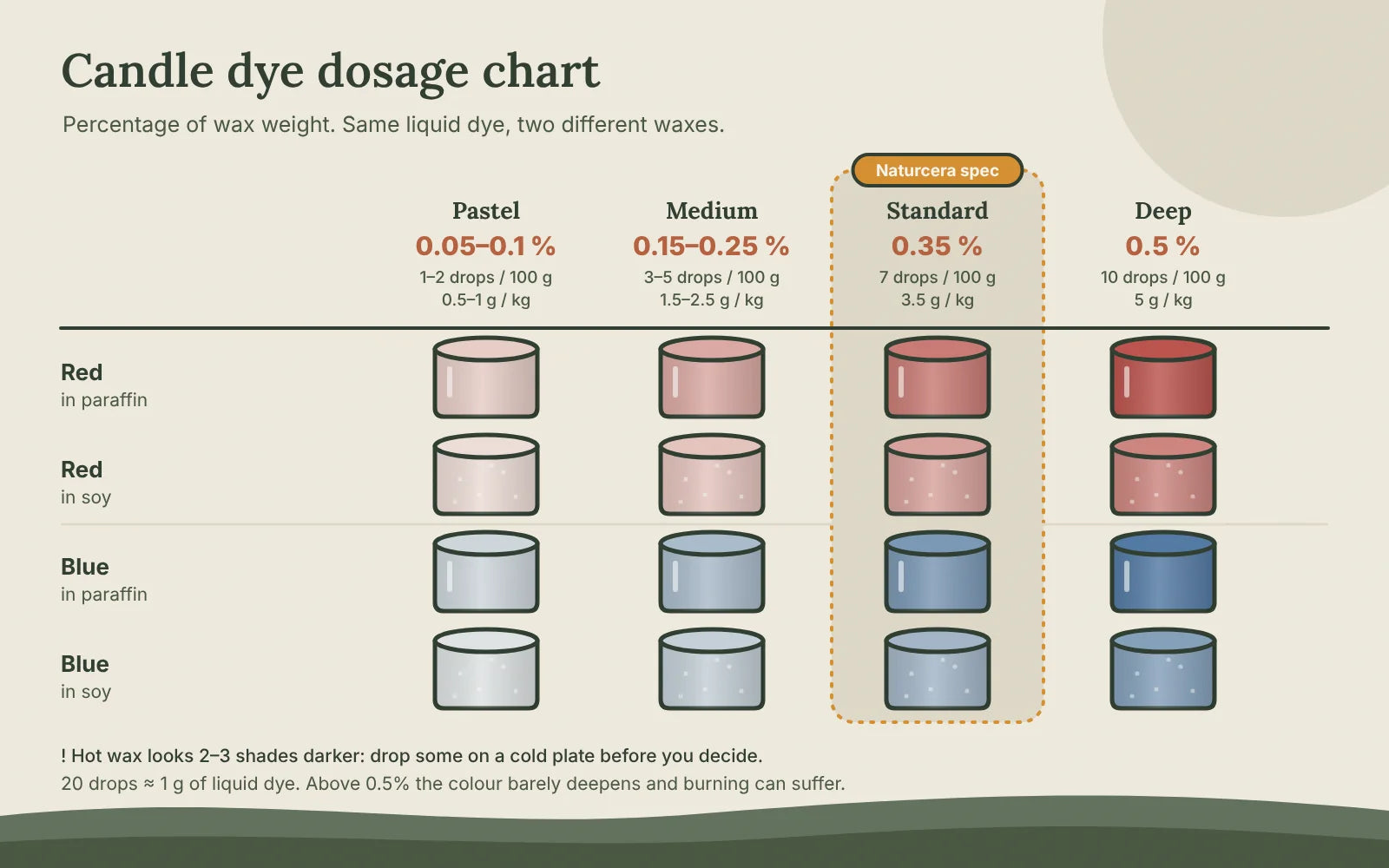
Dye is dosed as a percentage of the wax weight, just like fragrance. For our liquid dye, the spec sheet gives 7 drops per 100 g of wax, around 0.35 g (0.35%), with 20 drops to the gram. From there:
| Intensity | % of wax weight | Liquid dye per 100 g | Per 1 kg of wax |
|---|---|---|---|
| Pastel | 0.05–0.1% | 1–2 drops | 0.5–1 g (10–20 drops) |
| Medium | 0.15–0.25% | 3–5 drops | 1.5–2.5 g (30–50 drops) |
| Standard (Naturcera spec) | 0.35% | 7 drops | 3.5 g (70 drops) |
| Deep | 0.5% | 10 drops | 5 g (100 drops) |
These are starting points: yellow needs more than blue to show up, and pure black rarely stays black in soy. Solid dye works on the same principle, and each product page includes its own percentage chart in the images. As a sanity check, one 8 g block at 0.1% colours about 8 kg of wax; at 0.35%, a little over 2 kg.
If you already work out fragrance by percentage, nothing changes here. The formula is in our guide to calculating wax and fragrance quantities.
Soy vs paraffin: why the colour turns out different
Paraffin sets more translucent, so dye looks clean and saturated with a bit of sheen. Soy wax crystallises opaque and off-white, so the same dye reads lighter and more matte, usually in pastel territory. Soy also tends to frost (those white crystalline streaks), and frosting shows far more on a coloured candle than a white one.
- In soy, push the dose towards 0.35–0.5% for a "real" colour and accept a matte finish. Pastels are where soy shines.
- In paraffin, start low: 0.1–0.2% already gives a clear colour.
- In soy-paraffin blends, expect something in between.
Still choosing a wax? Our paraffin vs soy wax comparison covers the other differences.
When and how to add the dye
- Melt the wax to its usual temperature. For our BPF soy, up to about 70 °C.
- Add dye before fragrance. Liquid: count the drops or, better, weigh them. Solid: shave or cut your piece and stir until not a speck remains; a few extra degrees help if it's slow.
- Stir calmly for at least a couple of minutes, without whisking air in.
- Cold test: a drop on a cold plate or spoon. Hot wax looks 2–3 shades darker.
- Add fragrance, stir and pour. Judge the final colour once the candle has cured for a day or two.
Mixing colours without making mud
Yellow, red (or magenta) and blue get you almost anywhere. Always mix in drops and write the recipe down per 100 g of wax: it's the only way to repeat a shade next batch.
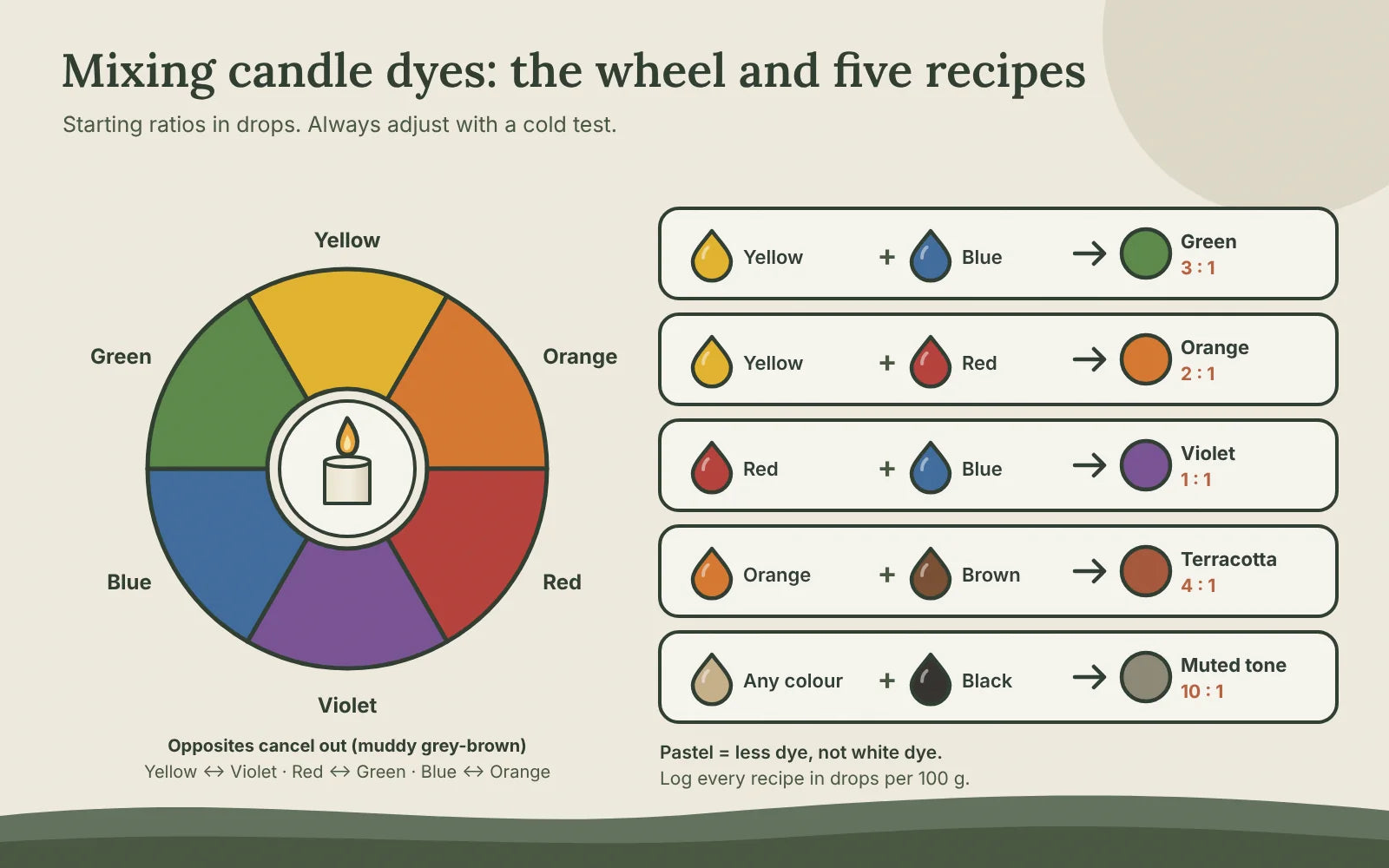
- Pastel doesn't mean "add white": it means use less dye.
- Earthy and muted tones: one drop of brown or black per ten drops of base colour knocks it back without dirtying it.
- Watch the opposites (yellow–violet, red–green, blue–orange): together they make grey-brown.
- Fragrance tints too. Vanilla and cinnamon notes tend to yellow or brown the wax over time. Build that into your recipe.
Dye and burning: what can go wrong
A soluble dye at a normal dose doesn't noticeably change the flame. Problems show up in three cases:
- Pigment or mica in the wax: it collects on the wick, the flame shrinks and eventually drowns.
- Overdosing: a heavily dyed wax is harder work for the wick. If you push the dose for a very dark shade, repeat the burn test and consider the next wick size up.
- Light: dyes fade in sunlight and under bright shop lighting. Store stock and finished candles out of direct light.
Pour 100 g test batches into identical small jars, one per dose, and label them. Five minutes of work saves you melting 2 kg of a pink you never wanted.
Keep drops for testing and weigh dye on a 0.01 g scale. For large batches, make a concentrate: dissolve, say, ten times the dose in part of the wax, then let it down into the rest for a more even colour. Log wax and dye batch numbers for every run. For regular orders or more than 500 kg, write to contacto@naturcera.com.
Frequently asked questions
How many drops of dye per kilo of wax?
With Naturcera liquid dye the reference dose is 70 drops per kilo (about 3.5 g, or 0.35%). For a pastel, 10 to 20 drops; for a deep shade, up to around 100.
Can I use food colouring in candles?
No. It's water-soluble and won't blend with wax: you get specks of colour, it sinks to the bottom and it can spit as it burns.
Why is my soy candle lighter than I expected?
Soy wax sets opaque and off-white, which lightens any colour. Raise the dose towards 0.35–0.5% and judge the shade cold, not in the pouring jug.
Can I colour candles with crayons?
It's not a good idea. Crayons contain pigment and fillers that don't dissolve; they build up on the wick and choke it.
Does dye affect how a candle smells?
Not at a normal dose. The reverse does happen, though: some fragrances, vanilla in particular, can darken the colour over time.
Materials for this project
For this guide, start with candle colourants that fit the final application, then validate the complete formula in a small test before scaling.
