

Sinkholes by the wick, cracks, hidden cavities and “wet spots” where the wax pulls away from the jar all have the same root: wax shrinks as it goes from liquid to solid. What changes is where it shrinks and how fast. The fixes are preheated jars, slow cooling, a second pour and the right wax for each type of candle.
In 30 seconds
- All wax contracts as it cools. The centre sets last and sinks: that is your sinkhole by the wick.
- Holes and hidden cavities: poke relief holes by the wick and top up with reserved wax.
- Cracks: cooling too fast, or a wax that is too hard for container candles.
- Wet spots and pull-away: cold jars or uneven cooling. Preheat jars to about 40 °C and cool at 20-22 °C.
- No stearic acid in BPF container soy: it makes the wax pull away and crack. For moulds, use moulding wax.
For this guide, start with candle waxes that fit the final application, then validate the complete formula in a small test before scaling.
Why it happens: wax shrinks as it cools
Liquid wax takes up more space than the same wax once solid. When you pour, it starts setting wherever it loses heat first: the bottom, the sides of the jar and the top. The centre, around the wick, is the last part to solidify, and by then there is no liquid wax left to fill the space it has lost. The result is a crater on top or, if the surface sealed first, a cavity hidden inside.
The same contraction, if the jar was cold or one side cooled faster than the other, pulls the wax away from the glass. And if cooling was sudden, the surface goes tense and cracks.
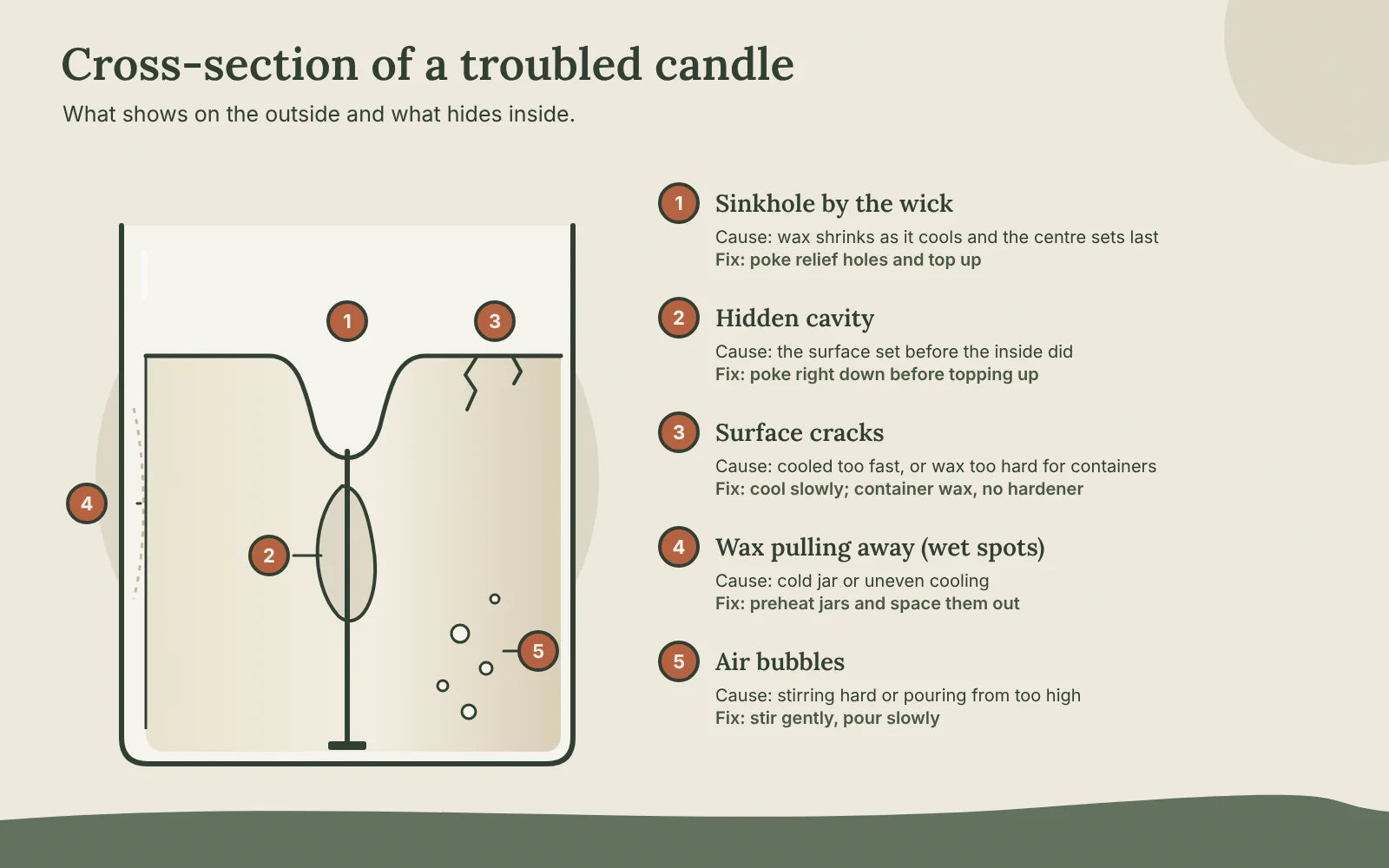
Quick diagnosis: what you see, why, and the fix
| Symptom | Most likely cause | Fix |
|---|---|---|
| Sinkhole around the wick | Normal contraction; fast cooling makes it worse. | Relief holes and a second pour, or a heat gun if it is shallow. |
| Hidden cavity (the top caves in when lit, or odd tunnelling) | The surface sealed before the inside set. | Poke right down to the bottom before topping up. |
| Surface cracks | Sudden cooling (fridge, draught) or wax too hard for containers. | Cool slowly; container wax without hardeners; reflow with heat. |
| Wet spots / wax pulling away | Cold, dirty or uneven glass; candles cooled touching each other. | Clean, preheated jars; space candles out; cool at 20-22 °C. |
| Bubbles and pitting | Stirring hard, pouring from too high. | Stir gently, pour slowly down the side, tap the jar. |
| Sunken base on a moulded candle | Contraction in a mould always leaves a dip in the part that is uppermost when poured. | Second pour; it is part of the process, not a fault. |
Sinkholes by the wick: the second pour
In candles more than a few centimetres tall, a central sinkhole is almost a given. The professional answer is not to avoid it but to fill it:
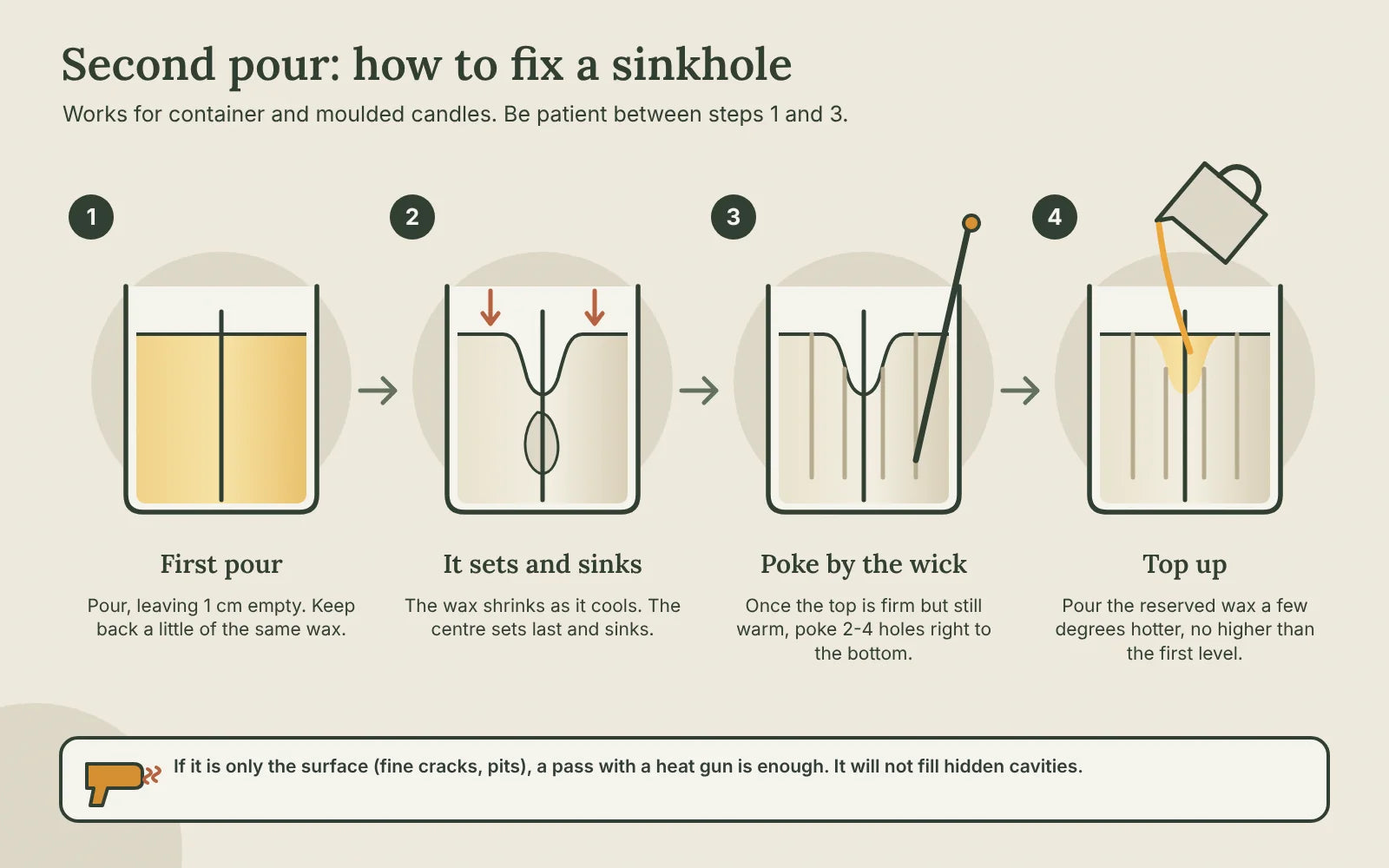
- Keep some wax back. Set aside about 10% of the same batch (with its fragrance and colour) before pouring.
- First pour. Fill to roughly 1 cm below the final level.
- Let it set. The top should be firm but the candle still warm. In a medium jar that is usually an hour or two.
- Poke by the wick. With a skewer, make 2-4 holes right to the bottom. That breaks open any cavities you cannot see.
- Top up. Pour the reserved wax about 5 °C hotter than the first pour so it bonds with the wax below, no higher than the first level: if you cover the already-set rim, you will get a line.
If the crater is shallow, a pass with a hot air gun melts the top layer and levels it. Bear in mind that heat only works on the surface and will not fill hidden cavities.
Cracks: cooling too fast, or the wrong wax
A candle cooled in the fridge, by a window or on a stone worktop sets on the outside long before the inside, and the surface cracks as the core shrinks. Always cool at a steady room temperature, out of draughts, with the candles spaced apart.
The other cause is the wax. A hard moulding wax shrinks too much and turns brittle inside a jar. Our APF moulding soy wax, for example, is for moulds only: in a container it tends to crack. For container candles, use BPF soy.
Stearic acid hardens wax and helps release from the mould, which is why it works in moulded candles (2-5% depending on the wax). In BPF container soy it does the opposite of what you want: the wax pulls away from the glass and cracks. Our guide to stearic acid for candles covers it in detail.
Wet spots and wax pulling away from the jar
There is nothing wet about wet spots: they are areas where the wax has separated from the glass, leaving a thin layer of air that looks darker from outside. They do not change how the candle burns, but in a clear jar they spoil the look. To reduce them:
- Clean, dry jars. Washed with soapy water and dried thoroughly; fingerprints and dust stop the wax from gripping.
- Preheated jars. A few minutes in the oven at about 40 °C, or a heat gun run round the inside just before pouring. Cold glass chills the wax suddenly at the wall.
- Even cooling. A room at 20-22 °C, candles about 10 cm apart (sides facing a neighbour cool more slowly) and on a rack or wood, not marble or metal.
- Glass of even thickness. Thick and thin areas cool at different rates. If wet spots bother you, choose opaque or coloured jars, which also hide frosting.
- Stable storage. Candles that go from cold to warm (a van, a shop window) can pull away weeks after they were made.
With soy, the odd small wet spot is normal. With paraffin, which shrinks more, they are more common.
Moulded candles: here shrinkage is on your side
In a pillar or moulded candle, shrinkage is exactly what lets you release it. What you need to manage is the dip it leaves in the top as poured (which becomes the base): the same second pour sorts it. For moulds, work with waxes made for the job: APF soy (melt at 70-75 °C, pour at 65-70 °C, cool 12-24 h before releasing) or rapeseed moulding wax (best poured at 70 °C). There are more tips in our guide to silicone mould candles without breakage.
In production, these defects are usually about process rather than wax: jars coming in cold from the warehouse, trays stacked with no gaps, or a unit that drops in temperature overnight. Measure and log pour, jar and room temperature for each batch and the pattern shows up quickly. If you need soy, rapeseed or paraffin wax in quantity, email contacto@naturcera.com: orders over 500 kg are handled by our sales team.
Frequently asked questions
Why does my candle have a hole next to the wick?
Because wax shrinks as it cools and the centre sets last. Poke by the wick once the top is firm and top up with reserved wax a few degrees hotter.
Why is the wax pulling away from the jar?
Usually a cold jar or uneven cooling. Preheat jars to about 40 °C, cool at 20-22 °C with candles spaced out and avoid hardening additives in container wax.
Do wet spots affect the burn?
No. They are air between the wax and the glass: a cosmetic issue. The candle burns the same.
Can I fix cracks with a heat gun?
Surface cracks, yes: it melts a few millimetres and closes them. If there are cavities inside, you need relief holes and a second pour.
Can I add stearic acid to stop soy cracking?
Not in container candles: with BPF soy it causes exactly that, pull-away and cracks. Use it in moulded candles, at 2-5% depending on the wax.
Materials for this project
For this guide, start with candle waxes that fit the final application, then validate the complete formula in a small test before scaling.
