


Selling candles in the EU means meeting three sets of rules at once: the GPSR (an identifiable manufacturer, batch number, warnings and a technical file), CLP (a hazard label when the fragrance classifies the candle) and IFRA (every fragrance used within its candle limit, backed by a certificate). The standards EN 15494, 15493 and 15426 fill in the safety pictograms and fire behaviour.
In 30 seconds
- GPSR (Regulation (EU) 2023/988), applicable since 13 December 2024: manufacturer’s name, postal and email address, a batch number, warnings in the local language and a technical file kept for 10 years.
- CLP (Regulation (EC) 1272/2008): a scented candle is a mixture. Depending on the fragrance and its load, it may need a pictogram and H/P statements, or at least the EUH208 statement.
- IFRA: candles fall under Category 12. Ask for the IFRA certificate, SDS and allergen declaration of every fragrance.
- Online: the product listing must show the manufacturer, a photo, product identification and warnings.
For this guide, start with candle fragrances that fit the final application, then validate the complete formula in a small test before scaling.
Which rules apply to a candle sold in the EU?
| Rule | What it covers | Mandatory? | Key document |
|---|---|---|---|
| GPSR · Regulation (EU) 2023/988 | General safety, traceability, online sales, accidents | Yes, for every candle sold to consumers | Risk analysis and technical file |
| CLP · Regulation (EC) 1272/2008 | Classification and labelling of chemical hazards | Yes, if the candle is classified or needs EUH208 | Fragrance SDS and mixture calculation |
| IFRA Standards (51st Amendment) | Limits on fragrance ingredients by product type | Industry self-regulation; required in practice | Supplier’s IFRA certificate |
| EN 15494, EN 15493, EN 15426 | Pictograms, fire safety, soot | Voluntary, but the technical benchmark | Warning label and test results |
GPSR: what it has required since 13 December 2024
Candles have no product-specific EU law, so Regulation (EU) 2023/988 is their main framework.
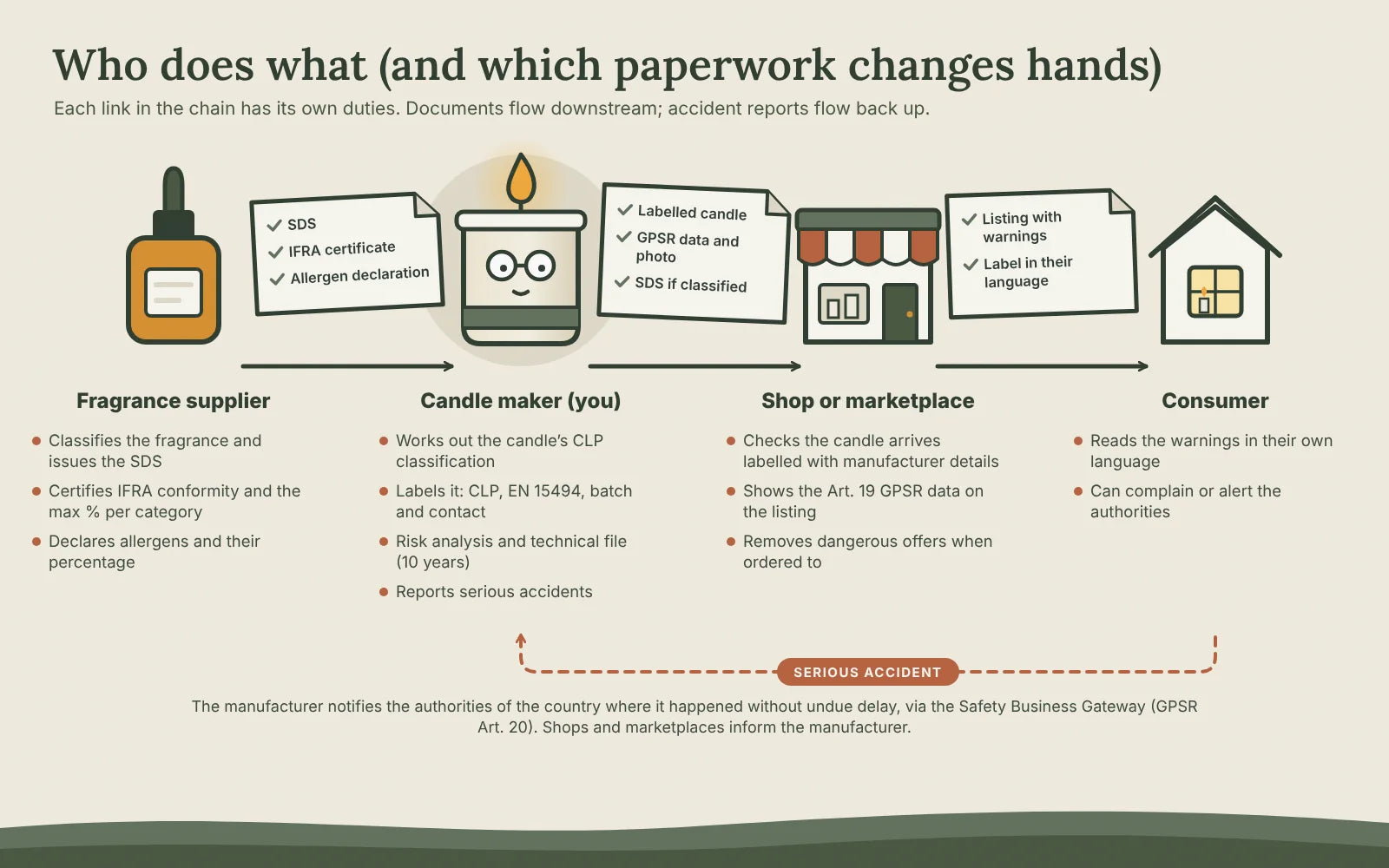
Who is the manufacturer, and who is the EU responsible person?
If you pour the candle and sell it under your brand, you are the manufacturer. So are you if you sell someone else’s candles under your own name. If the manufacturer is outside the EU (a UK or US workshop, for instance), the product needs an economic operator established in the EU (Art. 16), whose details must also appear on the product, packaging, parcel or an accompanying document. For UK makers this is the step most often missed. An EU-based maker covers this role already.
Traceability: batch and contact details
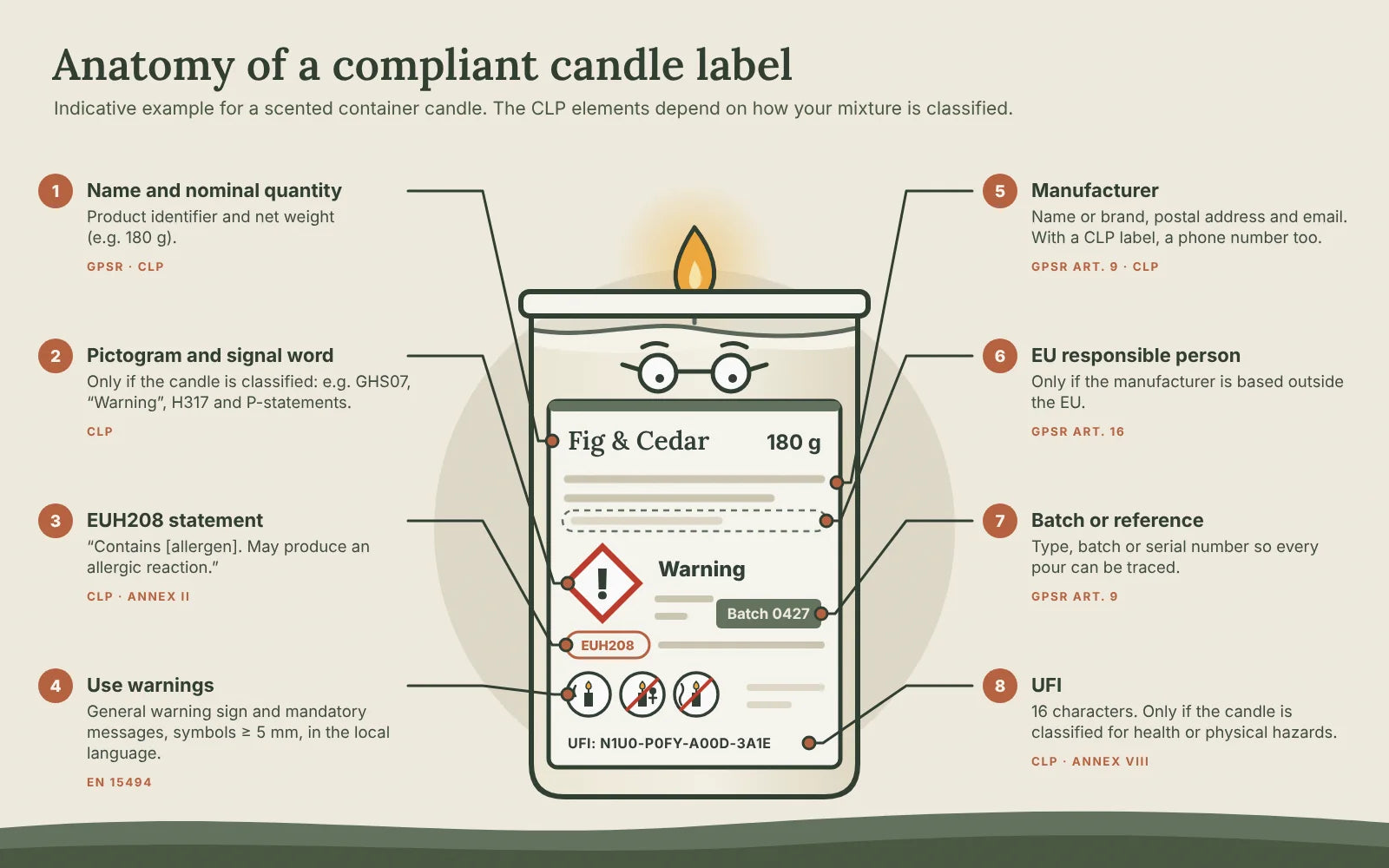
Article 9 requires on the product (or, if it doesn’t fit, on the packaging or an accompanying document):
- A type, batch or serial number. For a small maker, one number per pour is enough, linked to your records of wax and fragrance batch.
- Your name or brand, postal address and electronic address. A website does not replace a postal address.
Warnings must be in the language each Member State requires: selling to France means French, to Germany German.
Risk analysis and technical file
Before you sell, you carry out an internal risk analysis and draw up technical documentation: description, materials, risks (flame, hot glass, stability, allergens) and how you control them. Keep it for 10 years and hand it to the authorities on request. It includes SDSs, IFRA certificates and burn tests. An oversized wick gives a tall flame and soot, so test several sizes of candle wicks with your wax and vessel.
Online sales: what the listing must show
Article 19 requires every distance-sales offer to show clearly:
- Manufacturer: name or brand, postal and electronic address.
- EU responsible person, if the manufacturer is outside the EU.
- Product identification: photo, type and any other identifier.
- Warnings in the local language, the same as on the label.
Accidents and marketplaces
If a candle causes an accident resulting in death or serious harm to health, the manufacturer notifies the authorities of the country where it happened, without undue delay, through the Safety Business Gateway (Art. 20). Marketplaces have their own duties (a contact point, removing dangerous offers within two working days when an authority orders it), which is why they now ask for this data when you list a product. They do not take over your role as manufacturer.
CLP: when does my candle need a hazard label?
Under CLP a candle is a mixture. Wax is usually unclassified; fragrance often isn’t. What counts is the percentage of each hazardous substance in the finished candle.
How the calculation works, with an example
Section 3 of the fragrance SDS lists the classified substances and their concentration. Take a fragrance containing 8% of a Category 1B skin sensitiser:
- At a 10% fragrance load, the candle contains 0.8%. That is below the 1% that triggers classification as a sensitiser (H317), but above 0.1%: you need the EUH208 statement “Contains [substance]. May produce an allergic reaction.”
- At 12.5%, the candle reaches 1%: H317, the GHS07 pictogram, the signal word “Warning” and precautionary statements.
For Category 1A sensitisers the thresholds are ten times lower (0.1% and 0.01%), and some substances carry specific limits. Repeat the exercise for aquatic hazards, which add up across ingredients.
What a CLP label contains and where it goes
If the candle is classified: product identifier, supplier’s name, address and phone number, nominal quantity, pictograms, signal word, H and P statements, EUH208 and UFI where relevant, in the official language of the country of sale. It must be firmly fixed to the container or packaging, not to the wax. For packs of 125 ml or less, CLP Annex I (section 1.5.2.1) lets you omit the H and P statements for certain categories, such as skin or eye irritation Category 2 or chronic aquatic hazard Categories 1 and 2 (for aquatic Category 3, only the P statements). Skin sensitisation Category 1 is not among them, and the pictogram and signal word stay: check the version in force for what applies to your classification.
UFI and poison centres
If the candle is classified for health or physical hazards (H317 is a health hazard), you must submit a poison centre notification (PCN, via ECHA’s portal) in every country where you sell it, and print your own 16-character UFI on the label. The fragrance’s UFI won’t do. A candle that only carries EUH208 is not classified and needs no UFI.
The revised CLP: what changes and when
Regulation (EU) 2024/2865 amended CLP and entered into force on 10 December 2024. Its label formatting rules (minimum font size, layout) and the duty to show hazard elements in distance sales were postponed to 1 January 2028 by Regulation (EU) 2025/2439. In June 2026, Parliament and Council reached a provisional agreement on a simplification package (“Omnibus VI”) with a minimum x-height of 1.2 mm for products for the general public and 0.9 mm for packs of 125 ml or less, which would also push most of the changes back to 2030. As of October 2026 it had not yet been published in the Official Journal, so check the version in force before redesigning your labels. Already today, an online advert for a classified mixture must mention its hazard types.
IFRA: what it is and which certificate to ask for
IFRA (International Fragrance Association) publishes Standards that ban or restrict fragrance ingredients depending on the finished product. It isn’t law, but it is the benchmark used to judge whether a use is safe.
- Category: candles are Category 12 (products not intended for direct skin contact). Categories 11A and 11B cover other products.
- Current amendment: the 51st, notified on 30 June 2023 and applicable to existing creations too since 30 October 2025. The 52nd closed its consultation on 12 June 2026; notification is expected in January 2027, with 11 months’ transition for new creations and 30 for existing ones.
- IFRA certificate: issued by the fragrance supplier, stating the amendment and the maximum use level per category. File it with your technical documentation.
The Category 12 maximum is usually high, often more than a wax can hold. Your real limit is the lowest of three: the certificate, what the wax retains without sweating (in soy wax, Naturcera recommends 6–10% of the wax weight for its fragrance oils) and the load at which your CLP label changes.
EN standards: pictograms and fire
| Standard | Content |
|---|---|
| EN 15494:2019 | Safety labels: general warning sign and three mandatory messages (never leave unattended, keep away from children and pets, keep away from things that can catch fire). Symbols at least 5 mm. |
| EN 15493:2019 | Fire safety: stability, flame height, secondary ignition, self-extinguishing. |
| EN 15426:2018 | Sooting behaviour. |
They are not mandatory in themselves, but they are what an authority usually checks a candle against; if you want a presumption of conformity, check the current list of standards published in the Official Journal. Container candles may need extra warnings, and a heat-resistant candle jar takes one risk off your analysis.
Checklist before selling into another EU country
- Per fragrance: current SDS, IFRA certificate (51st Amendment) and allergen declaration.
- CLP calculation at your load: classified, EUH208 only, or nothing? If classified, UFI and PCN in each country.
- Label in the local language: name, weight, manufacturer, batch, CLP elements and EN 15494 warnings.
- Technical file on record, with burn tests and batch log.
- Online listing with manufacturer, photo, identification and warnings.
- Incident plan: how to recall a batch and notify via the Safety Business Gateway.
Naturcera candle fragrances come with a safety data sheet, an IFRA certificate and an allergen certificate: what you need for the CLP calculation and your technical file. If one is missing, ask contacto@naturcera.com, quoting the product reference.
With five markets, the bottleneck isn’t wax: it’s five label languages, five PCNs and paperwork that must match batch by batch. A short list of fragrances with stable documentation, bought by volume, keeps it manageable. For orders above 500 kg, our sales team prepares documentation by reference and batch: contacto@naturcera.com.
Guidance based on the official texts as of October 2026. Not legal advice: for your specific case, consult a regulatory specialist or the competent authority.
For legal requirements, always check the current EU General Product Safety Regulation (GPSR), ECHA Poison Centres guidance for UFI/PCN where applicable, and the official IFRA Standards documentation. IFRA standards do not replace applicable legislation.
Regulations for selling candles and scented waxes · How to start a candle business: channels, requirements and first steps
FAQ
Does an unscented candle need a CLP label?
Usually not, as waxes are generally unclassified. GPSR duties and the EN 15494 warnings still apply.
I make candles in the UK. Do I need an EU responsible person?
Yes, to sell into the EU you need an economic operator established in the EU, named on the product or packaging and in your listings. EU-based makers cover this role themselves.
Is an IFRA certificate a legal requirement?
Not directly, but it is the standard way to show a fragrance is used within safe limits, and buyers and marketplaces ask for it.
What about candles I put on sale before 13 December 2024?
Products placed on the market before that date in line with the old directive can still be sold. Anything placed on the market afterwards must comply with the GPSR.
Materials for this project
For this guide, start with candle fragrances that fit the final application, then validate the complete formula in a small test before scaling.
