

The RAL quality mark for candles (RAL-GZ 041) is a voluntary German quality label awarded by the Gütegemeinschaft Kerzen e. V., the candle manufacturers’ quality association. It certifies that a candle is made from tested, low-contaminant raw materials and, in lab tests, burns with little soot or smoke, without dripping and with a steady flame. You do not need it to sell candles in Germany; what you do need is compliance with the GPSR.
In 30 seconds
- Who awards it? The Gütegemeinschaft Kerzen e. V., recognised by RAL, the German Institute for Quality Assurance and Certification.
- What is tested? Purity of raw materials, dyes and lacquers, soot, dripping, burn-down, flame and burn time.
- Mandatory? No. The GPSR is mandatory; EN 15493, EN 15494 and EN 15426 are the technical yardstick.
- For small brands: you can work to equivalent criteria without the mark – you just cannot claim to have it.
If you sell candles into Germany, Austria or on marketplaces with lots of German customers, you will see this mark on supermarket and drugstore shelves. German shoppers recognise it, and wholesale buyers sometimes ask about it.
Who awards the RAL quality mark for candles?
The scheme is run by the Gütegemeinschaft Kerzen e. V. (Candle Quality Association), based in Markdorf on Lake Constance. It is an association of candle manufacturers that has registered its quality and test specifications with RAL, the Deutsches Institut für Gütesicherung und Kennzeichnung, founded in 1925. Hence the name RAL-GZ 041: “GZ” stands for Gütezeichen (quality mark) and 041 is its number in the RAL system.
The logo shows a stylised candle flame with the RAL lettering. According to a 2016 report, the association then had around 35 member manufacturers from across Europe; for the current figure, ask the Gütegemeinschaft itself.
What is tested for the quality mark?
The association sums up its aim as low soot and smoke emissions and a clear reduction in toxic organic pollutants, achieved mainly through the choice of raw and auxiliary materials. On top of that comes consistent performance: burn time, burn-down, shape, colour and wick.
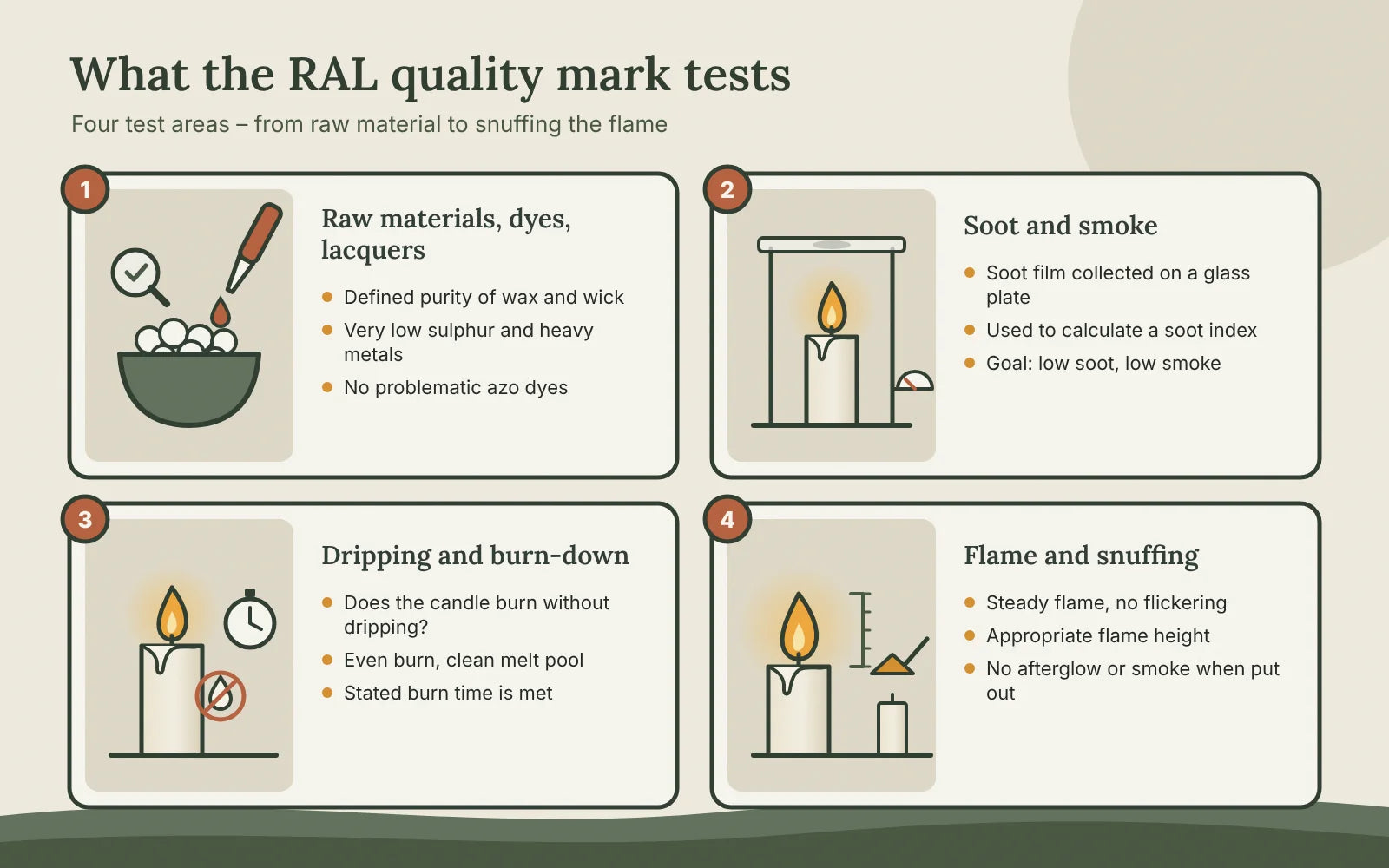
Raw materials, dyes and lacquers
Waxes, wicks, colourants and lacquers have to meet defined purity requirements. Sulphur and heavy-metal content must be very low, and azo dyes that can release carcinogenic aromatic amines are excluded. For paraffin, that means hydrogenated, highly refined grades in practice; stearin, beeswax and vegetable waxes have defined specifications too. The exact limits are set out in the full RAL-GZ 041 quality and test specifications.
Soot and smoke
The candle burns under a glass plate. The soot film that settles on it is measured optically: the less light the glass lets through, the higher the soot index. The same principle is described in EN 15426. The maximum permitted value is set in the association’s quality and test specifications.
Dripping, burn-down and burn time
The lab checks that the candle does not drip, that it burns down evenly and that the burn time printed on the pack is accurate. According to a 2016 report on the test practice, larger candles burn in four-hour cycles with a one-hour break, and at least three candles per line are tested – ten for tealights. What counts is the current version of the test specifications.
Flame and snuffing
The flame should be calm and even, without flickering or smoking, and the wick should not keep glowing for long after it is put out. The wick does most of the work here: too heavy for the diameter and the flame grows and soots; too light and it drowns in its own wax.
Who can carry it, and how do you get it?
The mark is used by manufacturers who formally commit to the association’s quality and test specifications and pass its tests. The association awards the mark after a passed initial test, normally to its members. Whether a non-member can use it, and on what terms, has to be clarified directly with the Gütegemeinschaft. In broad strokes:
- Application to the Gütegemeinschaft Kerzen and acceptance of its rules.
- Initial testing of the products by a recognised lab. DEKRA acts as a testing body for this mark.
- Award of the right to use the mark for the tested products.
- Monitoring: ongoing in-house checks plus regular external monitoring. Breaches can lead to a warning, a penalty or withdrawal of the mark.
The association does not publish prices. The total combines membership fees, test fees per product line and the external monitoring, which the mark user pays for; fees are not public and are available on request from the Gütegemeinschaft.
Is the RAL mark mandatory?
No. Nobody needs it to sell candles in Germany or anywhere else in the EU. What is mandatory is different: since 13 December 2024 the General Product Safety Regulation (GPSR, Regulation (EU) 2023/988) applies. It requires a safe product, a risk analysis, technical documentation, labelling and manufacturer details. The European candle standards are voluntary, but in practice they are the yardstick for what “safe” means.
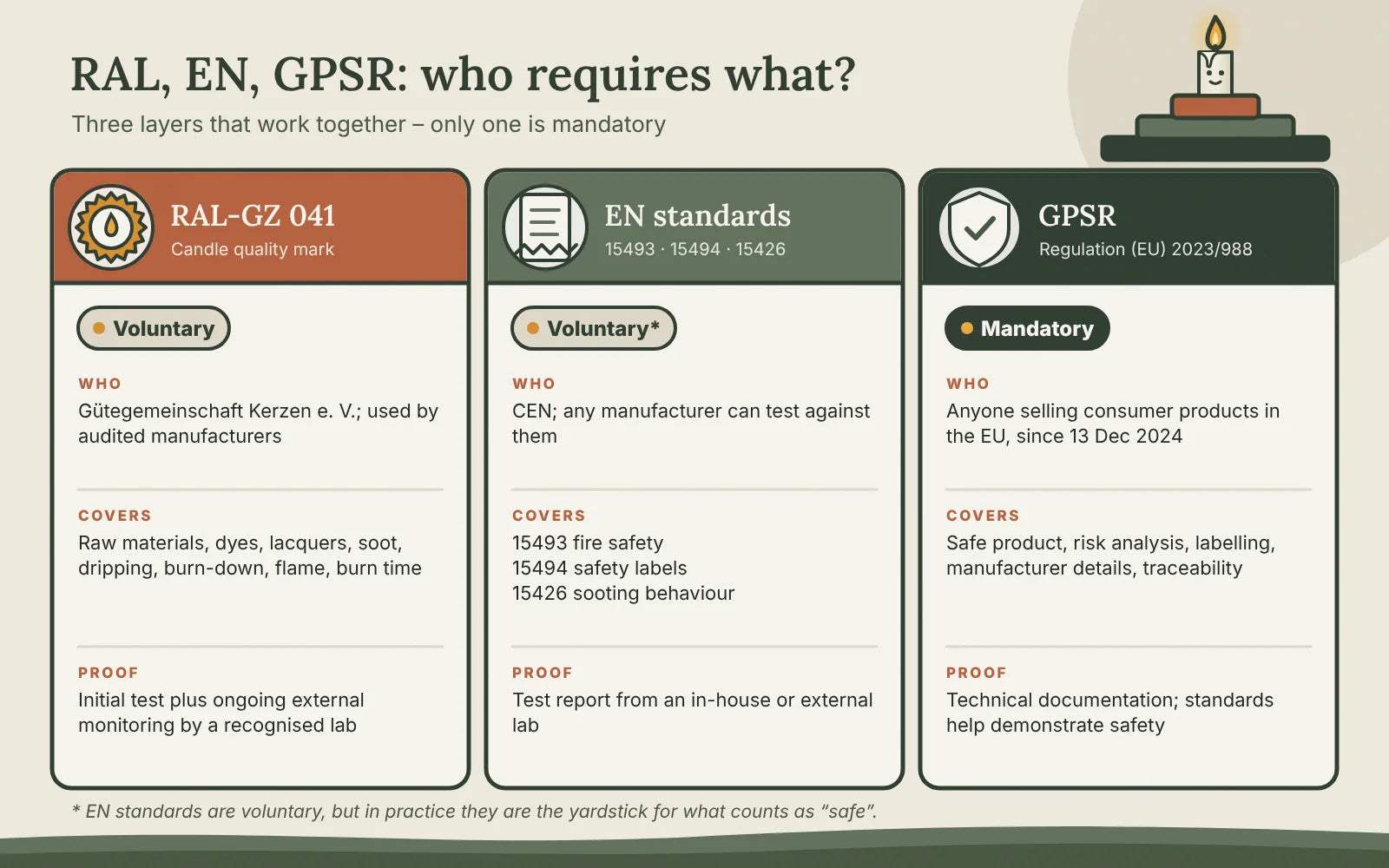
| Reference | Status | What it covers |
|---|---|---|
| GPSR (EU) 2023/988 | Mandatory | General product safety, documentation, traceability |
| EN 15493 | Voluntary | Fire safety of indoor candles |
| EN 15494 | Voluntary | Safety warnings and pictograms on candle or packaging |
| EN 15426 | Voluntary | Measuring sooting behaviour (soot index) |
| RAL-GZ 041 | Voluntary | Raw-material quality, pollutants, burning behaviour, ongoing monitoring |
The difference is the level of ambition. The EN standards set the minimum a candle must meet to be considered safe. The RAL mark goes further on raw materials and pollutants and adds permanent monitoring. And a RAL candle is still subject to the GPSR like any other.
What does this mean for a small candle brand?
For a workshop making a few hundred candles a month, membership and monitoring are usually out of proportion. But the criteria are no secret, and you can work along the same lines:
- Documented raw materials: keep technical and safety data sheets for every wax, fragrance and colourant. Our fragrance oils come with IFRA, CLP and SDS documents; our plant waxes come with their technical data.
- A correctly sized wick: choose it by diameter, wax type and fragrance load, and test it for every recipe. See our range of candle wicks.
- Your own burn tests: burn several candles per recipe in three- to four-hour cycles and log flame height, melt pool, soot and afterglow.
- Clean colour: use colourants made for wax and keep the dose low. Ours are under candle dyes.
- Labelling to EN 15494 and GPSR details on every pack – in German if you sell in Germany.
The RAL mark is protected. Showing it without a licence, or advertising “RAL-tested”, can earn you a cease-and-desist letter under German unfair-competition law. Describe what you actually do instead: “Every recipe is burn-tested over several cycles before it goes on sale.”
If you are considering the RAL mark or supplying German retail chains, what counts is a stable raw-material base: consistent batches, certificates of analysis and up-to-date SDS. For orders from 500 kg our sales team will help you directly at contacto@naturcera.com.
Frequently asked questions
Is a candle without the RAL mark worse?
No. The mark is voluntary and costs money, and plenty of good candles do not carry it. It only shows that the manufacturer submits to external testing and monitoring.
Does the RAL mark exist for scented candles?
Yes, it can also be awarded to candles with fragrance. For the fragrance itself, the IFRA standards and CLP labelling apply as well.
Can a small brand outside Germany get the RAL mark?
In principle yes, if it meets the quality and test specifications, passes the tests and covers the costs. Whether it pays off depends on volume and channel; for German retail it can be a selling point.
Does the RAL mark replace GPSR documentation?
No. The GPSR applies to every candle sold to consumers in the EU, with or without a quality mark. RAL test reports can, however, add to your technical documentation.
Raw materials with data sheets
Waxes, wicks, dyes and fragrances, with the documents you need for your own quality control.
