

A 180 g soy candle in a glass jar costs about €5.50 to make if you buy wax in 20 kg sacks and pay yourself for your time: roughly €4 in materials and €1.50 in labour. With the usual pricing rule (cost × 2 for wholesale, × 2 to 2.5 for retail), that candle sells to shops for about €11.50 excluding VAT and to customers for roughly €28–35 including VAT.
In 30 seconds
- A candle cost sheet adds up wax, fragrance, wick, jar, label, box, waste and labour.
- Wax is only 14% of the cost. The jar, the fragrance and your time weigh more.
- Going from 1 kg to 100 kg of wax cuts the price per kilo by 35%, but the candle by only 11%.
- Rule of thumb: full cost × 2 = wholesale price; × 2 to 2.5 = retail price. Keep one retail price across all channels.
For this guide, start with soy waxes that fit the final application, then validate the complete formula in a small test before scaling.
How much does it cost to make a candle? A 180 g example
We costed a real candle from the catalogue: a 225 ml glass jar (74 mm opening), 180 g fill, BPF container soy wax with 8% fragrance by weight of wax and a cotton wick for 6–7 cm diameters. Prices are from naturcera.com as of October 2026, with Spanish VAT included.
| Item | Purchase price | Per candle | Cost per candle |
|---|---|---|---|
| BPF soy wax | €4.50/kg (20 kg sack) | 167 g | €0.75 |
| Fragrance oil | €70 per litre (≈ €0.07/ml) | 13 g (8%) | €0.91 |
| Cotton wick 6–7 cm | €7 per pack of 50 | 1 | €0.14 |
| 225 ml jar | €15 per pack of 12 | 1 | €1.25 |
| Label | printer estimate | 1 | €0.20 |
| Box | printer estimate | 1 | €0.60 |
| Waste | 5% of materials | — | €0.19 |
| Materials | €4.04 | ||
| Labour | €15/h | 6 min | €1.50 |
| Cost per candle | €5.54 |
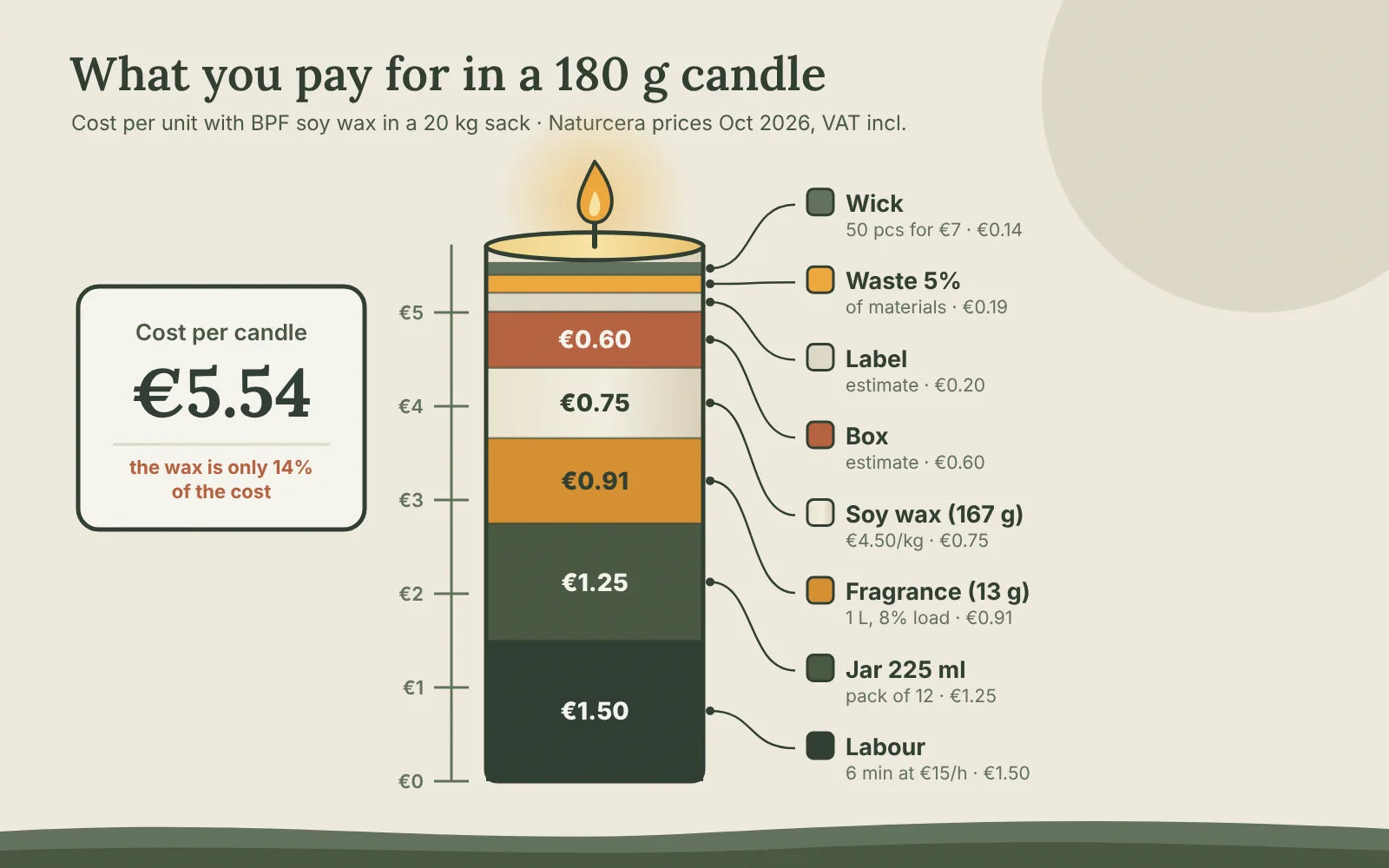
Three notes to keep the maths honest:
- Fragrance is weighed. We take 1 ml ≈ 1 g here, which is an approximation; check the density on the SDS if you want to be exact. Our fragrance oils are dosed at 5–10% of the wax weight depending on the scent (each product page says), and BPF soy wax takes 8–10%. For exact grams, see our guide to calculating wax and fragrance quantities.
- Label and box are estimates. They depend on your printer, the paper and the run. Use your real figure. Many brands skip the box at markets and use it online.
- Your time counts. Six minutes per candle covers weighing, melting, pouring, centring the wick, labelling and packing, spread over a batch. If you don’t pay yourself, the business isn’t profitable; it only looks it.
How much do you save buying 1 kg, 20 kg or 100 kg of wax?
BPF soy wax drops from €6.50/kg in a 1 kg bag to €4.50/kg in a 20 kg sack and €4.20/kg at 100 kg. At 500 kg it reaches €3.55/kg. Here is the same candle at each step:
| Wax purchase | Wax per candle | Fragrance per candle | Cost per candle | Candles per purchase |
|---|---|---|---|---|
| 1 kg at €6.50/kg | €1.09 | €1.17 (250 ml bottle) | €6.17 | ≈ 6 |
| 20 kg at €4.50/kg | €0.75 | €0.91 (1 litre) | €5.54 | ≈ 120 |
| 100 kg at €4.20/kg | €0.70 | €0.91 (1 litre) | €5.49 | ≈ 600 |
Prices as of October 2026, VAT included. Check the product page for current prices.
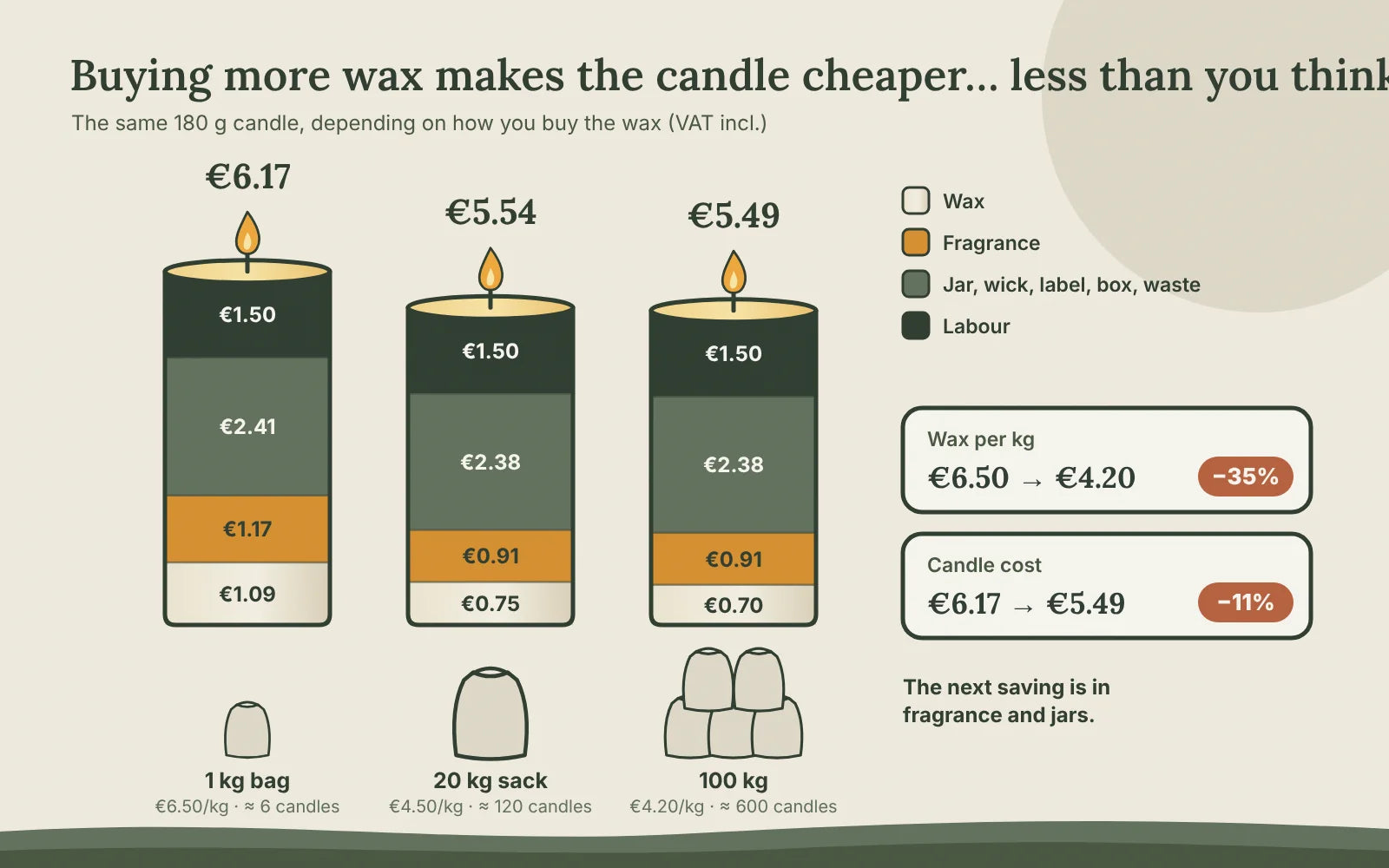
The takeaway: the big jump is from the trial bag to the 20 kg sack. After that, savings come from fragrance and packaging. Ordering wax and candle fragrance oils together also cuts shipping costs per unit.
The costs nobody puts on the cost sheet
On top of what goes into each candle, some costs are there whether you sell 10 or 1,000 units:
- Burn tests, samples and candles that fail.
- Energy, utensils, moulds and scales.
- Website, photos, payment and marketplace fees, shipping you don’t charge for.
- Social security or self-employment contributions, product liability insurance, an accountant, market stall fees.
Until you have measured them, add them as a percentage of cost: 10–20% is a sensible starting figure. We use 15% below.
How to price candles: the formula
- Full cost. (Materials + labour) × (1 + overheads).
- Wholesale price (to shops). Full cost × 2. That margin pays for your brand, your mistakes and your growth.
- Retail price. Wholesale × 2 to 2.5. That is the margin a shop needs to give you shelf space.
- Add VAT to the retail price for consumers.
The full example, excluding VAT
If you are VAT-registered and reclaim input VAT, your material cost is the net figure. Prices on the site include 21% Spanish VAT, so €4.04 becomes €3.34. Buying as a business from another EU country? Send us your VAT number before ordering and we’ll tell you how the invoice is handled.
| Step | Calculation | Result |
|---|---|---|
| Materials excl. VAT | €4.04 ÷ 1.21 | €3.34 |
| + Labour | 6 min at €15/h | €4.84 |
| Full cost | €4.84 × 1.15 | €5.57 |
| Wholesale price | €5.57 × 2 = €11.13 | €11.50 (rounded) |
| Retail excl. VAT | €11.50 × 2 to 2.5 | €23.00–28.75 |
| Retail incl. VAT (e.g. 20%) | × 1.20 | €27.60–34.50 |
If you use a small-business VAT exemption, you don’t charge VAT but can’t reclaim it either. In that case, cost your materials with VAT included (€4.04) and don’t add VAT to your selling price.
Direct sales vs selling to shops: one retail price
When you sell yourself (markets, your website, commissions), you keep the whole gap between cost and retail price, but you pay for the channel: pitch fees, commissions, shipping, hours of customer service. When you sell to shops, you get the wholesale price in exchange for bigger orders and no counter to staff. The rule that avoids trouble: the retail price on your website must match the price in the shops that stock you. Undercut them online and no shop will reorder.
If you sell to customers at €15 today, you can’t sell to shops at €11.50 tomorrow: they’d have to retail at €25–28 what you sell for €15. Set your retail price with the wholesale channel in mind, even if you don’t have it yet.
Candle cost sheet template
One row per material, with your real figures. Cost per candle is always purchase price ÷ quantity bought × quantity used.
| Item | Purchase price (excl. VAT) | Quantity bought | Per candle | Cost per candle |
|---|---|---|---|---|
| Wax | €… | … g | … g | €… |
| Fragrance | €… | … ml | … ml | €… |
| Wick | €… | … pcs | 1 | €… |
| Container and lid | €… | … pcs | 1 | €… |
| Label and box | €… | … pcs | 1 | €… |
| Waste | 5% of total materials | €… | ||
| Labour | €…/h | minutes per candle ÷ 60 | €… | |
| Overheads | 10–20% of the above | €… | ||
| Full cost | × 2 = wholesale · × 2 to 2.5 = retail excl. VAT | €… | ||
Once production is steady, the next saving is fragrance by the litre and containers by the case. For wax orders from around 500 kg, or fragrance in formats above one litre, our sales team will quote you directly: contacto@naturcera.com or +34 618 08 43 43.
Frequently asked questions
How much does it cost to make a soy candle?
A 180 g jar candle costs €4.00–4.70 in materials, VAT included, depending on how much wax you buy. Add 6 minutes of work at €15/h and you’re at €5.50–6.20 per candle.
How much should I sell my candles for?
Using cost × 2 × 2–2.5, a 180 g jar candle retails at roughly €28–35 including VAT. Below that range there is no margin left to sell to shops.
What is a normal markup for candles?
Double the full cost for the wholesale price (a 50% gross margin), then multiply that by 2 or 2.5 for the retail price, which is the margin shops usually expect.
Is buying wax in bulk worth it?
Yes, especially going from 1 kg to 20 kg: BPF soy wax drops from €6.50 to €4.50/kg. Beyond that, the saving per candle is small; the next saving is in fragrance and containers.
Should I calculate costs with or without VAT?
If you reclaim VAT, work without it and add it at the end to the retail price. If you can’t reclaim it, use VAT-inclusive prices as your cost.
Materials for this project
For this guide, start with soy waxes that fit the final application, then validate the complete formula in a small test before scaling.
