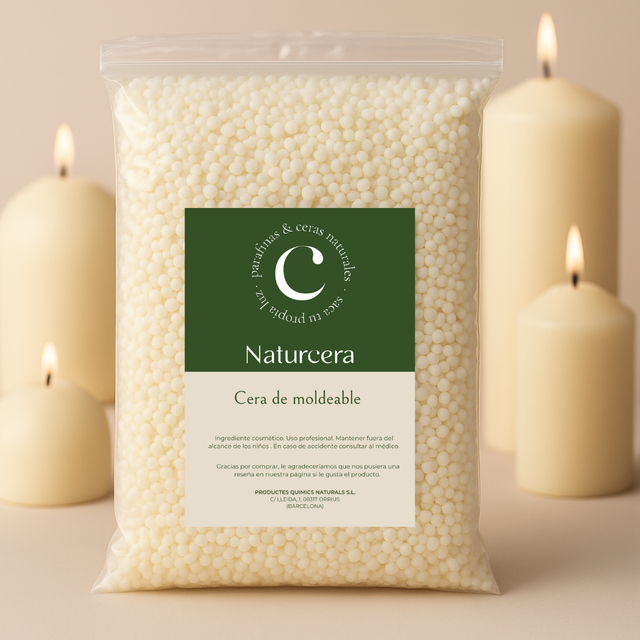
Moldable Soy Wax APF – Plant-Based and Hard for Molded Candles
Moldable Soy Wax APF – Plant-Based and Hard for Molded Candles - 1 kg is backordered and will ship as soon as it is back in stock.
The more you buy, the more you save
Move up to 20 kg and pay €4,95/kg (29 % less per kg).
Do you want to buy more than 500 kg? Contact us.
The shipping cost will be calculated automatically at checkout.
*The glass container is a decorative item not included in the order.

Secure payment
Visa and Mastercard

Large stock

High quality

24/48h shipping

Moldable Soy Wax APF – Plant-Based and Hard for Molded Candles

Description
Description
Main description:
APF soy wax is a vegetable wax with a high melting point (57-63°C), specially formulated for making molded candles: pillars, taper candles, decorative figures, and any candle that needs to maintain its shape without a container.
Unlike BPF soy wax (for containers), APF provides the hardness and consistency needed for proper unmolding without deformation. It retains all the benefits of soy: 100% plant-based origin, clean burning, and a naturally neutral scent.
✨ Why choose APF soy wax:
✅ Superior hardness – Ideal for molded candles that retain their shape ✅ 100% plant-based – Sustainable and renewable ✅ Easy unmolding – Contracts slightly, making removal easier ✅ Clean burning – No black smoke or soot ✅ Accepts fragrance – Up to 8% fragrance ✅ Natural matte finish – Professional handcrafted appearance
📊 Technical specifications:
| Property | Value |
|---|---|
| Primary use | Molded candles (pillars, tapers, figures) |
| Form | Flakes / beads |
| Color | Creamy white |
| Melting point | 57-63°C |
| Pouring temperature | 65-70°C |
| Fragrance percentage | 6-8% |
| Origin | Plant-based (hydrogenated soybean oil) |
| Burning | Clean and even |
| Storage | Cool, dry place (~25°C) |
🕯️ How to make molded candles with APF soy wax:
1. Prepare the mold Clean the mold thoroughly. If it is silicone, you do not need mold release. If it is metal or hard plastic, apply mold-release spray or vegetable oil.
2. Position the wick Pass the wick through the mold opening and secure it with putty or tape at the base. Tighten the wick well with a holder at the top.
3. Melt the wax Heat the wax to 70-75°C (10-15°C above the melting point). Make sure it is completely transparent and free of crystals.
4. Add fragrance and dye At 65-70°C, add fragrance (6-8%) and dye if desired. Stir well.
5. Pour into the mold Pour at 65-70°C (±5°C). Avoid drafts and sudden temperature changes to minimize cracks.
6. Cool slowly Let it solidify completely without moving it (12-24h depending on size). Slow cooling reduces cracks and frosting.
7. Unmold Once completely cool, carefully remove it from the mold. Soy wax is less rigid than paraffin, so do not force it.
💡 Professional tips:
⚠️ Difference from BPF: APF is harder (for molds), while BPF is softer (for containers). Do not interchange them. ⚠️ Internal cracks: Crystals may appear if the wax is not melted properly. Make sure the wax is transparent. ⚠️ Frosting (white spots): This is natural in soy wax. To minimize it, cool the wax very slowly.
❓ Frequently asked questions:
Can I use APF wax for container candles? Technically yes, but it is too hard and may crack as it contracts. BPF is better for containers.
Why does my candle have a frosted white layer? This is "frosting," characteristic of plant-based waxes. It is natural and does not affect performance. Some people consider it a mark of authenticity.
Can I mix APF with paraffin? Yes, but you will lose its 100% plant-based character. If you need more hardness, it is better to add stearic acid (2-5%).
Which wick should I use for molded soy candles? It depends on the diameter. For 6-7cm pillars, use a cotton wick suitable for that range. Soy burns cooler than paraffin, so choose an appropriate wick.